
The short version
- Best base for most families: Benalmádena. On the airport train, calm beaches, and more to do than anywhere else on the coast.
- Easiest arrival: Torremolinos — five minutes from the airport on the train.
- Best free afternoon: Paloma Park in Benalmádena. Playgrounds, a lake, and peacocks wandering loose.
- The day trip worth prioritising: the Nerja Caves. €10 per person, under-5s free, and a 32-metre stalagmite that genuinely impresses children.
- You don’t need a car if you stay between Málaga and Fuengirola. You do if you want the white villages.
- The thing nobody warns you about: Spanish lunch runs 14:00–16:00 and dinner starts around 21:00. Plan around it or you’ll spend the week in empty restaurants.
Top 3 Family Hotels on the Costa del Sol
Where we’d stay with two kids, ranked by what kind of family you are.
Holiday World Resort, Benalmádena
Pools, organised entertainment and all-inclusive options, in the town with Paloma Park, the cable car up Mount Calamorro and the Sea Life aquarium. Fifteen minutes from the airport on the train. Our pick for school-age kids.
Check pricesOccidental Torremolinos Playa
Five minutes from the airport — which with a pushchair, two suitcases and an overtired toddler is worth more than any facility. Kids’ area with slides, mini golf, a kids’ club, and two pools.
Check pricesSercotel Málaga
Where we stayed in Málaga. Five minutes from the bus station, ten from the beach, connecting rooms with two bathrooms, and welcome packs for the boys at check-in. Museums, the old town and espetos on the beach all within reach.
Check pricesThese are affiliate links — we earn a small commission if you book through them, at no extra cost to you. We only recommend hotels we’ve stayed in ourselves.
We live in Spain, and the Costa del Sol is a coast we keep coming back to with our two boys — Málaga, Nerja, Frigiliana, Benalmádena, Torremolinos, Puerto Banús. I also spent over a decade as a hotel account manager with this coast as my territory, which means I knew where every hotel sat long before I ever booked one for my own family.
This is what we’ve actually learned, including the bits we got wrong.
Is the Costa del Sol good for families?
Yes — and the real reason is logistics rather than scenery.
The airport sits 8 km from Málaga and 5 km from Torremolinos, and a commuter train runs straight from the terminal down the coast. You land, walk to a platform, and you’re at your hotel in fifteen minutes for €1.80 a head. With a pushchair, two suitcases and a child who has been awake since 4am, that is worth more than any hotel feature in the brochure.
Beyond that: the beaches are wide and shelve gently, the towns are flat and walkable, and Spanish restaurants are relaxed about children in a way that surprises a lot of first-time visitors. Nobody will raise an eyebrow at a five-year-old at a dinner table at nine in the evening.
What’s less good, honestly: the heat. It hit 40°C on one of our Málaga days and only dropped to a survivable 24°C once we got to the beach in the evening. July and August on this coast mean planning your day around shade, and it’s why the indoor and green-space options below matter as much as the beaches. The busier resort strips can also feel dated in places, and parts of Puerto Banús are firmly nightlife territory rather than family territory.
Where to base yourself with kids
The short version of the decision — the full area-by-area comparison is in Where to Stay on the Costa del Sol.
| Base | From the airport | Train? | Best for |
|---|---|---|---|
| Torremolinos | 5 min | Yes | Toddlers, first trips, easiest logistics |
| Benalmádena | 15 min | Yes | Most families — the most to do |
| Fuengirola | 34 min | Yes | Longer stays, more space |
| Málaga city | 12 min | Yes | Older kids, museums, food |
| Marbella / Puerto Banús | 45–60 min | No | Teenagers, bigger budgets |
| Nerja | 45–55 min | No | Quieter — but you’ll want a car |
The single biggest booking mistake is choosing a town rather than a part of a town. Benalmádena alone covers a hilltop white village, a marina and a beach strip — twenty minutes apart and three different holidays. Check where your hotel actually sits before you book, not after.
Hotels we’ve stayed in along this coast:
- Occidental Torremolinos Playa — laid out like a small village of separate buildings rather than one tower. Two pool areas, one with sea views and one beside the gym and activity zones; a kids’ area with slides, mini golf and a kids’ club. Half board runs from dinner on the arrival day to breakfast on the departure day, and you get a wristband at check-in. Minutes from the airport.
- Sercotel Málaga — five minutes’ walk from the bus station, ten from the beach. They gave us connecting rooms with two bathrooms, which is the single most useful thing a hotel can do for a family of four, and the boys got welcome packs at check-in.
- Occidental Puerto Banús — two pools with a proper adults/children split. Better for school-age kids and teenagers than for toddlers.
Benalmádena: the most to do in one place
If we were choosing one town for a week with children, this is it.
Paloma Park is the one I’d push hardest, and it’s free. A large green space with a small lake, several playgrounds, and ducks, rabbits and peacocks roaming loose around the paths. It will absorb an entire afternoon, and it’s the answer on the day the beach is too hot.
The Teleférico cable car climbs Mount Calamorro for panoramic views along the whole coast. On a clear day you can see Gibraltar and the coast of Morocco from the top — which is a genuinely memorable thing to show a child.
Puerto Marina is the yacht harbour, ringed with shops, cafés and restaurants, and home to the Sea Life Benalmádena aquarium. An easy half-day.
Benalmádena Pueblo is the hilltop white village — whitewashed houses, cobbled streets, flower-filled balconies, and the Castillo de Colomares, a monument to Christopher Columbus that looks like nothing else in Spain. Beautiful, and steep. Half a day, and I’d skip it with a pushchair.
The beaches: Playa de Santa Ana, Playa Bil Bil and Playa Malapesquera, all with swimming, sunbathing and water sports.
Tivoli World, the amusement park, is currently closed and undergoing updates with no announced reopening date. Check before you build a day around it — a lot of older guides still list it as open.
Full guide: Benalmádena Travel Guide
Málaga with kids
Málaga is a working city rather than a resort, and with children that’s an advantage — there’s more here than sand.
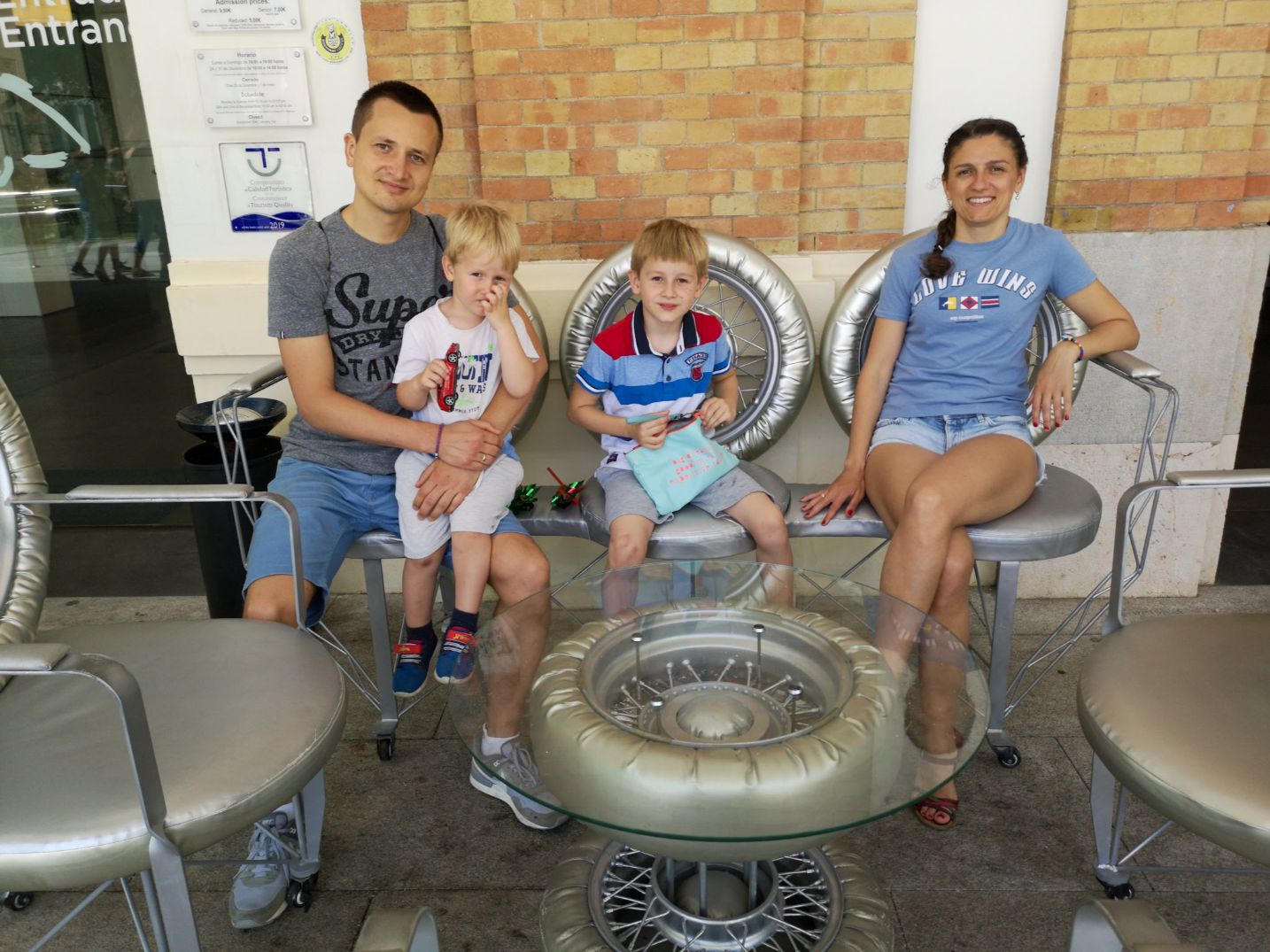
The Automobile Museum was the surprise of our trip. We’d been to the much bigger one in Turin and expected a let-down; instead Marc spent the whole visit on the interactive displays he could actually touch and play with, and we enjoyed it more than either of us planned to. Good option for a hot afternoon.
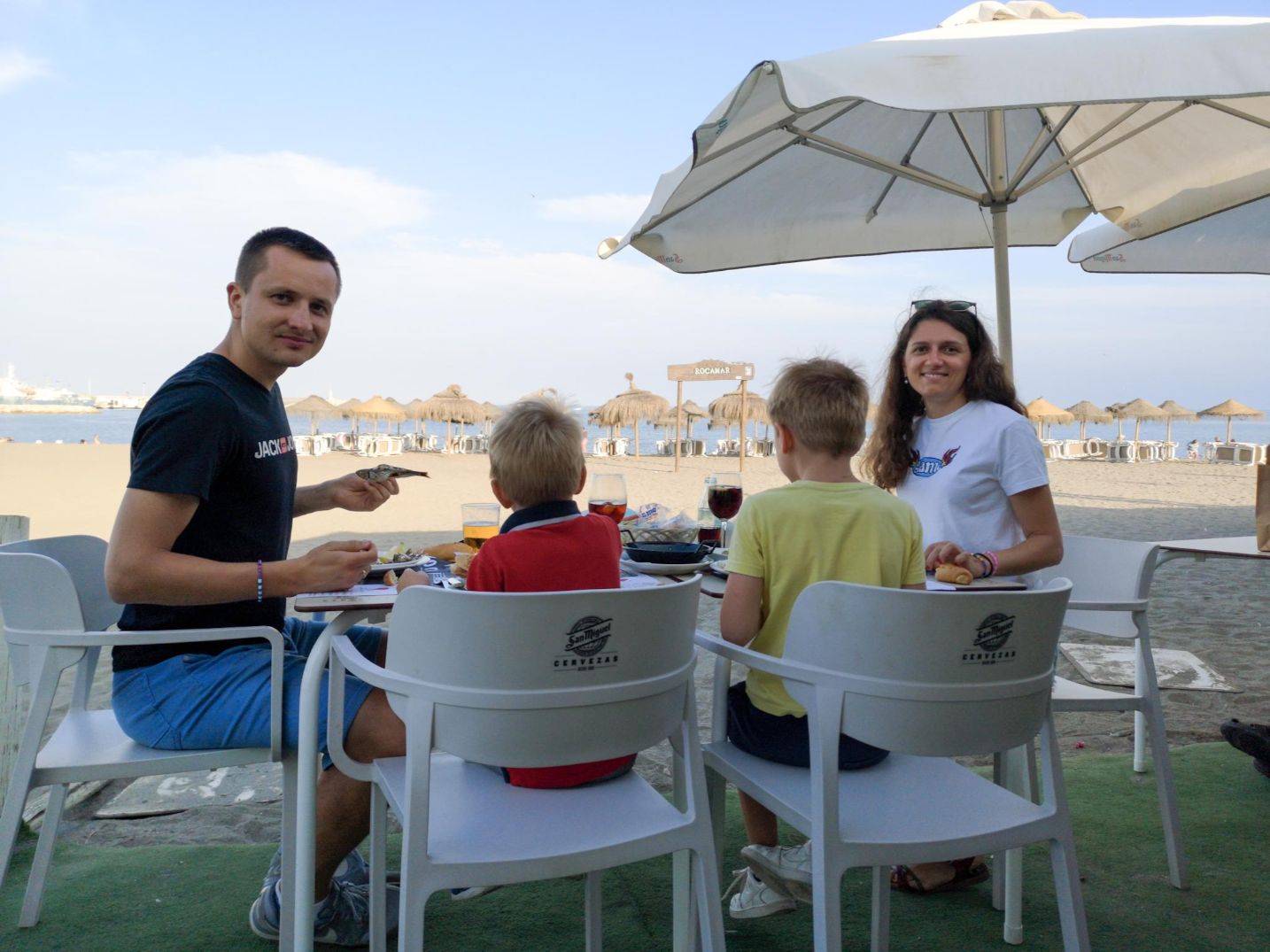
Espetos on the beach. This is the thing to do in Málaga with children, and it costs almost nothing. Sardines are speared onto bamboo or metal skewers, covered in coarse sea salt and grilled over an olive-wood fire on the sand at a chiringuito. We went in the evening, when the 40°C of the afternoon had dropped to 24°C, and it’s one of the boys’ clearest memories of the trip. Sardine season is summer, when they’re at their best.
Málaga Cathedral sits in the old town near everything else. Construction started in the 15th century and finished in the 18th, and there’s an audio tour with a reasonable entry price — worth an hour with older children, less so with small ones.
Parque de Málaga has a playground, and after a museum morning it does the essential job of tiring everyone out before dinner.
The LEGO exhibition is one of the largest in Europe. We got less out of it than we should have, purely because the kids were already done in by the time we arrived — go early in the day, not last.
The old town is narrow streets, pavement cafés, historic plazas, murals, mosaic floors and street art. Two shops worth finding: the artisanal dried-fruit sellers — ask for Marcona almonds, the big rounded ones, which are the best of them and grown across more than 16,000 hectares of the province — and the handmade leather shops.
More: Family Trip to Málaga with Kids
The Nerja Caves and Frigiliana: the day trip to prioritise
The one inland day I’d actually push, and the one where I can save you our mistakes.
The Nerja Caves
Nerja is 50 km from Málaga, with direct buses every 30 minutes.
- Tickets: €10 per person. Children under 5 go free.
- Entry includes an audio-guided tour and an audiovisual presentation.
- The caves were found by local boys in 1959, and the underground system stretches nearly 5 km, formed by karstic cavities over millions of years.
- Inside there are Paleolithic paintings and the world’s largest stalagmite — 32 metres high, with a base measuring 13 by 7 metres. That statistic lands with children in a way most sightseeing doesn’t.
- There’s a picnic area and a restaurant by the sea at the site.
The mistakes we made, so you don’t have to:
- We arrived at 1pm and didn’t get in until 3pm. The queues in high season are real. Go first thing.
- We bought a one-way bus ticket and then faced a two-hour wait for the return. We took a taxi instead — €8–10 from the caves into town, €15 over to Frigiliana. Book the return, or drive.
Balcón de Europa
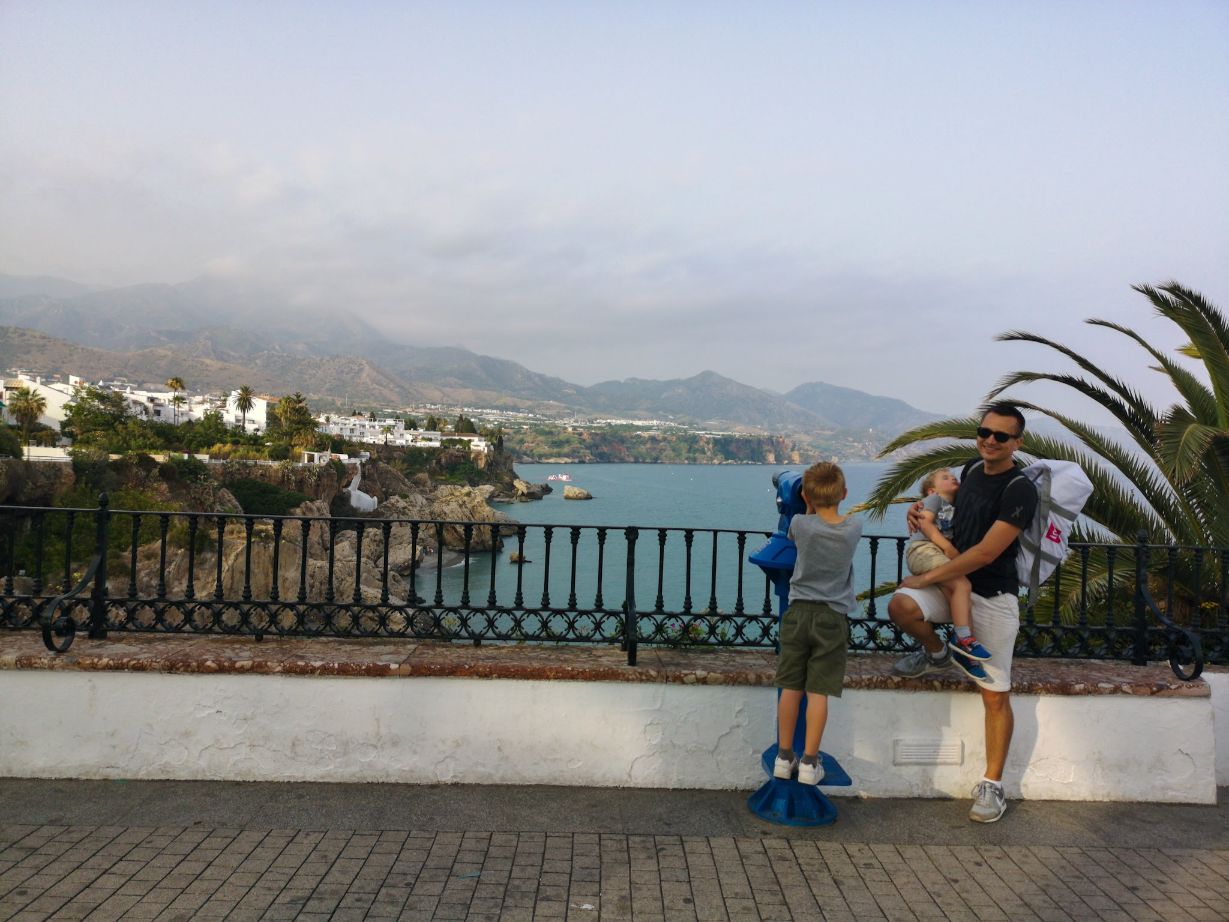
In the centre of Nerja, built on the foundations of an old fort: a palm-lined plaza with a panoramic view along the entire coastline. In the evening there are portrait artists, street entertainers and musicians, and it’s the sunset spot in town.
From there it’s a short walk down to Playa de Calahonda and Caletilla beach — a path down from the promenade, cliff-top restaurants looking over the sand, and a “hippie house” built into the rock that the boys were far more interested in than the view.
The town itself is a former fishing village: whitewashed houses, narrow streets, Spanish balconies, rocky coves and the Sierra de Almijara mountains behind.
Frigiliana
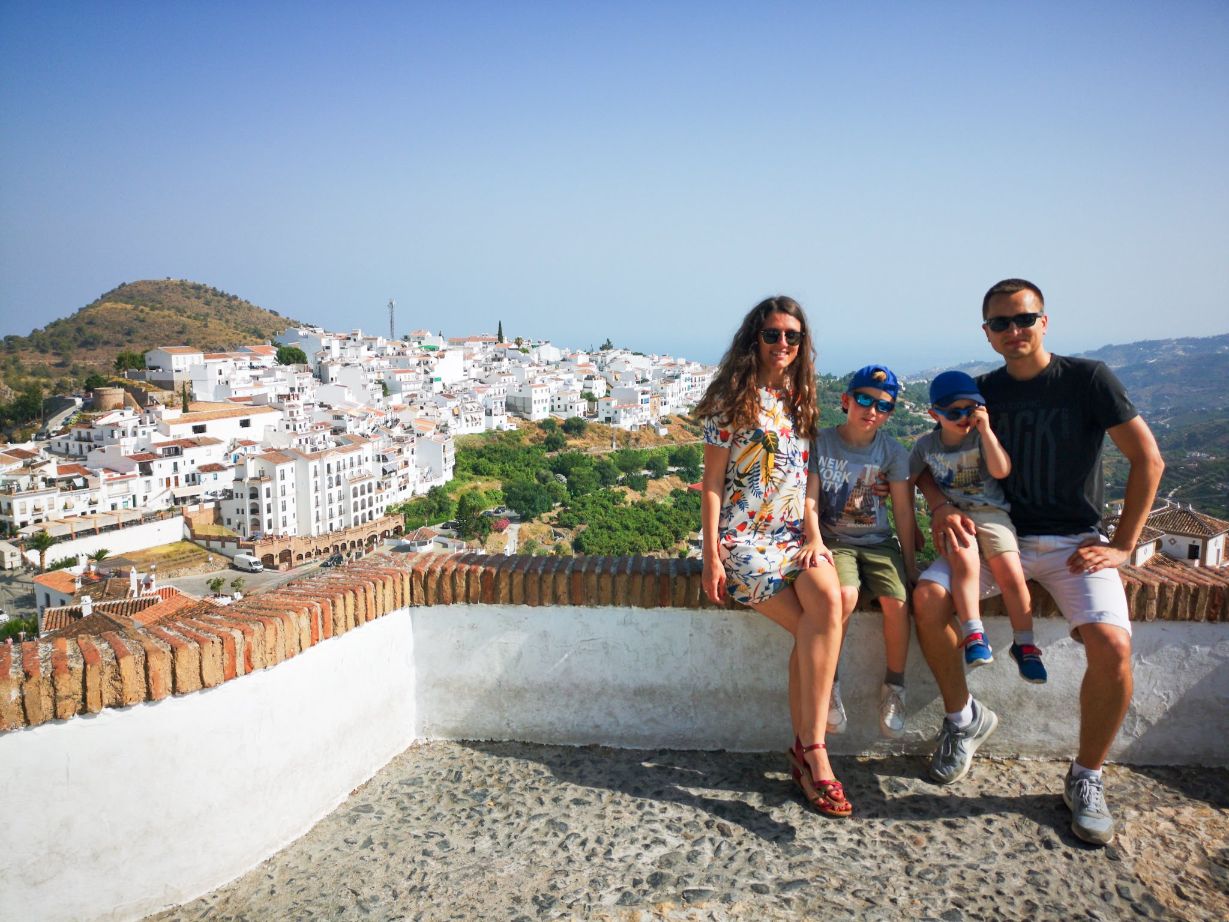
Twenty minutes up the hill from Nerja, and one of the prettiest white villages in Andalusia.
- Getting there: buses run from Nerja village roughly every 1.5 hours, which is not a lot. We took a taxi from the caves for €15. If you want to see more than one white village, hire a car.
- The Mudejar quarter is the old Moorish heart — narrow, cobbled, steep, and the views get better the higher you climb.
- Reales Pósitos is the village centre and the only street in the Mudejar quarter cars can reach, with the town hall, the church square and small shops. It gets busy.
- Calle Zacatín is the postcard street, lined with potted plants against whitewashed walls picked out in blue and purple.
- The Vista Panorámica viewpoint at the end of Calle del Peñón looks over the village rooftops to the mountains and the sea beyond.
- San Antonio church sits in the Plaza de la Iglesia.
- There’s a playground near the bus station — worth knowing after an afternoon of uphill cobbles.
Honest warning on Frigiliana: it is steep and it is cobbled. It is not a pushchair village. With a toddler you’ll be carrying them, and in August you’ll be carrying them in the heat.
And on the whole day: we did the caves, Frigiliana and Nerja town in one go with two small children, and I was surprised they made it. They did — but we went back to the hotel afterwards and did nothing else that day. Budget the recovery time.
More: Our Day Trip to Nerja with Kids · Frigiliana with Kids
Puerto Banús with children
Worth a visit, not a base.
The marina is more welcoming to families than its reputation suggests — it’s a safe, flat, easy stroll, there are ice cream counters and casual cafés alongside the Louis Vuitton and Dior windows, and the yachts hold a child’s attention for longer than you’d expect. Go in the evening, when the sun comes off the water and the whole place looks its best.
But the party-heavy parts of Puerto Banús are not where I’d put a family with small children overnight. Visit, eat, walk back.
More: Puerto Banús Marina
Eating out with kids on the Costa del Sol
The obstacle isn’t the food — Spanish restaurants genuinely welcome children. It’s the clock.
Lunch runs roughly 14:00 to 16:00. Dinner starts around 21:00. If your kids eat at 12:30 and 6pm, you will spend the week in empty restaurants being served by staff who haven’t started properly cooking yet.
What works for us:
- Push lunch to 13:30 at the earliest. Any earlier and the kitchen hasn’t hit its stride.
- Make lunch the main meal, the way Spanish families do, and keep dinner light. It also means the kids eat their proper meal before they’re exhausted.
- Chiringuitos on the beach are the easy answer — espetos, no dress code, sand underfoot, nobody minding noise.
- Paella is a lunch dish, not a dinner one, and it’s ordered by the pan for two or more people rather than as individual plates. Order the mixed or meat version for a fussy eater; seafood paella arrives with prawns in shells and mussels, which is a lot of work for a six-year-old.
More: Best Paella in Benalmádena
Getting around with kids
The C-1 train is the entire argument for this coast with a family. €1.80 to Torremolinos or Benalmádena, €2.70 to Fuengirola, level access from the airport station, and journeys short enough that nobody unravels.
Car or no car:
- No car for a beach week between Málaga and Fuengirola. Parking in these towns in summer is expensive and scarce, and you’d be paying to leave it standing still.
- Car for Frigiliana, Mijas Pueblo, Ronda or the Caminito del Rey — and for the Nerja day, if you’d rather not spend part of it waiting for a bus.
Child seats: Spanish law requires proper restraints, and a metered taxi from the airport rank won’t reliably carry them. Pre-book a private transfer and request them when you book.
At the airport: Málaga is stroller-friendly with baby changing stations throughout, and easy to navigate. The one thing to build in time for is security, which gets genuinely busy at peak times — arrive earlier than you would travelling alone.
Full detail: Málaga Airport to the Costa del Sol
When to go with kids
April to June and September to October are the best months on this coast — warm enough for the beach, and without the crowds or the prices.
July and August are what most families are stuck with, and they work, but plan around the heat: beach or pool early, something shaded or indoor in the middle of the day, and the evening outside. That’s the rhythm Spanish families use and it exists for a reason.
What I’d do differently
Book the return leg of every day trip before setting off. Two hours waiting for a bus outside the Nerja Caves with two tired children was entirely self-inflicted.
Go to the caves first thing, not after lunch. Two hours of the queue was avoidable.
Do the big indoor attraction early in the day. We reached the LEGO exhibition with nothing left in the tank and got a fraction of what we should have out of it.
With children under four, stay on the train line. Everything else is negotiable. That one isn’t.
Read next:
- Where to Stay on the Costa del Sol: Best Areas Compared
- Málaga Airport to the Costa del Sol: Transfers, Trains & Prices
- Occidental Torremolinos Playa Review
- Benalmádena Travel Guide
- Best Paella in Benalmádena
Frequently Asked Questions About the Costa del Sol with Kids
Is the Costa del Sol good for families with kids?
Yes, mainly because of how easy it is to get around. The airport is 8 km from Málaga and 5 km from Torremolinos, and the C-1 commuter train runs from the terminal down the coast to Fuengirola, so you can be at your hotel fifteen minutes after landing for €1.80 a person. The beaches are wide and shelve gently, the towns are flat and walkable, and Spanish restaurants are genuinely relaxed about children.
Where is the best place to stay on the Costa del Sol with kids?
Benalmádena, for most families — it sits on the airport train line and has the most to do within walking distance, including Paloma Park, the cable car up Mount Calamorro, the Sea Life aquarium at Puerto Marina and calm beaches. Torremolinos is the easiest arrival at five minutes from the airport and the best choice with toddlers, Fuengirola gives you more space for a longer stay, and Marbella suits older children and teenagers but has no train connection.
Do you need a car on the Costa del Sol with kids?
Not if you are staying between Málaga and Fuengirola — the C-1 train links Málaga, Torremolinos, Benalmádena and Fuengirola to the airport and to each other, and parking in these towns in summer is expensive and scarce. You do want a car for the white villages like Frigiliana and Mijas Pueblo, and for day trips to Ronda or the Caminito del Rey.
How much are tickets for the Nerja Caves?
Entry is €10 per person and children under five go free, which includes an audio-guided tour and an audiovisual presentation. Go first thing in the morning — we arrived at 1pm in high season and did not get in until 3pm.
Are the Nerja Caves worth visiting with children?
Yes. The caves were discovered by local boys in 1959, stretch nearly 5 km underground, and contain Paleolithic paintings and the world’s largest stalagmite at 32 metres high with a base of 13 by 7 metres — a statistic that lands with children far better than most sightseeing. There is also a picnic area and a restaurant by the sea at the site.
Is Frigiliana suitable for a pushchair?
No. Frigiliana’s Mudejar quarter is narrow, cobbled and steep, and with a toddler you will be carrying them for most of the visit. There is a playground near the bus station, and Reales Pósitos is the only street in the old quarter reachable by car.
What time do families eat in Spain?
Lunch runs from roughly 14:00 to 16:00 and dinner starts around 21:00, which is the single thing most visiting families underestimate. Push lunch to 13:30 at the earliest, make it the main meal of the day the way Spanish families do, and keep dinner light — beach chiringuitos serving espetos are the easiest option with children.
Is Tivoli World in Benalmádena open?
No. The amusement park is currently closed and undergoing updates, with no reopening date announced. A lot of older guides still list it as open, so check before planning a day around it.
