
Everyone in Barcelona goes to see Gaudí. The best building in the city was designed by someone else.
The Palau de la Música Catalana is a working concert hall by Lluís Domènech i Montaner, finished in 1908, and it is the only concert hall in the world on the UNESCO World Heritage list. A guided tour costs €24, a self-guided visit €20, and children under 10 go free — which the ticket resellers tend not to mention.
Here’s what you actually need to know before you book, and what the inside is like.
Quick answers
- Price: €24 guided tour · €20 self-guided with a brochure
- Children under 10: free, accompanied by an adult
- Under 35 and over 65: €20
- Catalonia residents: €14
- Book online — the box office charges €2 more per ticket
- Visiting hours: 09:00–15:30, every day. That’s the fact that catches people out
- How long: about 50 minutes
- Where: Carrer del Palau de la Música 4–6. Metro Urquinaona (L1, L4), or five minutes’ walk from Plaça Catalunya
- Bring a small bag. Large bags and suitcases aren’t allowed and there is no cloakroom on the visit route
Thanks to our collaboration with MegaPass, we joined a guided tour of Palau de la Música Catalana, and it quickly became one of our favorite cultural experiences in Barcelona.
🎟 Get your MegaPass for discounted access to Barcelona’s top attractions:
✅ Barcelona City Pass
✅ Most Popular Attractions
✅ Picasso Museum
✅ Cathedral of Barcelona

- Available
- Ticket
- Tour
- Choose 2 Top Attractions
- Cruise
- Mobile Ticket

How much does the Palau de la Música cost?
| Ticket | Price |
|---|---|
| Guided tour (general) | €24 |
| Self-guided visit with brochure | €20 |
| Reduced — over 65s and under 35s | €20 |
| Special reduced — disability below 65% | €12 |
| Children under 10 (with an adult) | Free |
| Disability above 65% | Free |
| Residents in Catalonia | €14 |
| Buying at the box office | +€2 per ticket |
Prices checked on the official site in September 2026. Themed and combined visits cost more — check when you book.
Three things worth pulling out of that table
1. Children under 10 are free, and nobody tells you. Look at the resale sites and you will find this remarkably hard to discover, for the obvious reason that they earn nothing on a free child. For a family of four with two young children that’s the difference between €48 and €96. You still need to include the children when you book, so they have a place in the group.
This is not unusual in Barcelona, by the way — under-11s are free at the Sagrada Família, under-12s at Casa Batlló and under-12s at La Pedrera. It is the single biggest saving available to a family visiting this city, and it is buried everywhere.
2. Under 35 pays €20. Unusual — most reductions start at 65. If you’re 34 you save €4 and probably don’t know it.
3. Book online. The box office adds €2 per ticket, which is the opposite of what most people assume. On four tickets that’s €8 for the privilege of queueing.
Guided tour or self-guided? The honest answer
€24 versus €20. Same building, same rooms, four euros apart.
Take the guided tour if this is your first time and you want to understand what you’re looking at. The Palau is a building where nearly everything means something — the muses, the ceiling, the proscenium, the ironwork — and almost none of it is self-evident. A guide is the difference between “that’s pretty” and understanding why it was built the way it was.
Take the self-guided visit if you’ve read a page like this one, you’d rather stand still and look, or you’re with young children whose tolerance for a 50-minute talk is limited. You are not being fobbed off: you see the same concert hall.
With children I’d take the self-guided option and move at their pace. With one adult and no children, the guide is worth the four euros.
The opening hours are the thing people get wrong
Visits run 09:00 to 15:30, every day. That’s it.
It sounds obvious written down, and it ruins a lot of afternoons. This is a working concert hall — the building has to be handed over to rehearsals and performances, so the visiting window closes at half past three while every other attraction in Barcelona is still open.
Plan it as a morning. Turning up at four o’clock because everything else in the city is open until seven is the commonest mistake made here.
(The ticket office keeps longer hours — Monday to Saturday 08:30 to 21:00 — but that’s for concert tickets, and it’s same-day sales only. It doesn’t extend the visiting window.)
What you actually see
Fifty minutes, and the building saves the best for the end.
The concert hall, and the skylight
You come up into the main hall and everyone looks up, because the ceiling is not a ceiling. It’s an enormous stained-glass skylight in the shape of an inverted dome, hanging down into the room in gold and blue like a drop of sun coming through the roof.
It does two jobs. In daylight it floods the hall with natural light from directly above. At night it’s lit from outside and works as the room’s lamp. Which means this is the only major concert hall in the world that can hold a daytime concert in natural light — it was built before electric lighting was reliable, and the solution was to let the sun in.
The part a guide will tell you and a brochure won’t: the reason the walls can be glass at all is that the building has a steel frame. The structure is carried by the steel, so the walls don’t have to hold anything up and could be given over almost entirely to glass. In 1908 that was genuinely radical, and it’s why UNESCO calls it “an exuberant steel-framed structure full of light and space.” Everything beautiful about the room follows from that one engineering decision.
The stage wall — the eighteen muses
Behind the stage, eighteen young women emerge out of the back wall, each playing a different instrument. They’re half sculpture and half mosaic: the upper bodies are carved and project into the room, the lower halves dissolve into flat ceramic panels behind.
The sculpture is by Eusebi Arnau, on ceramic by Mario Maragliano. Look for the point on each figure where three dimensions become two. Children find this section much more interesting than the architecture, because the women are clearly coming out of the wall.
The proscenium and the corner
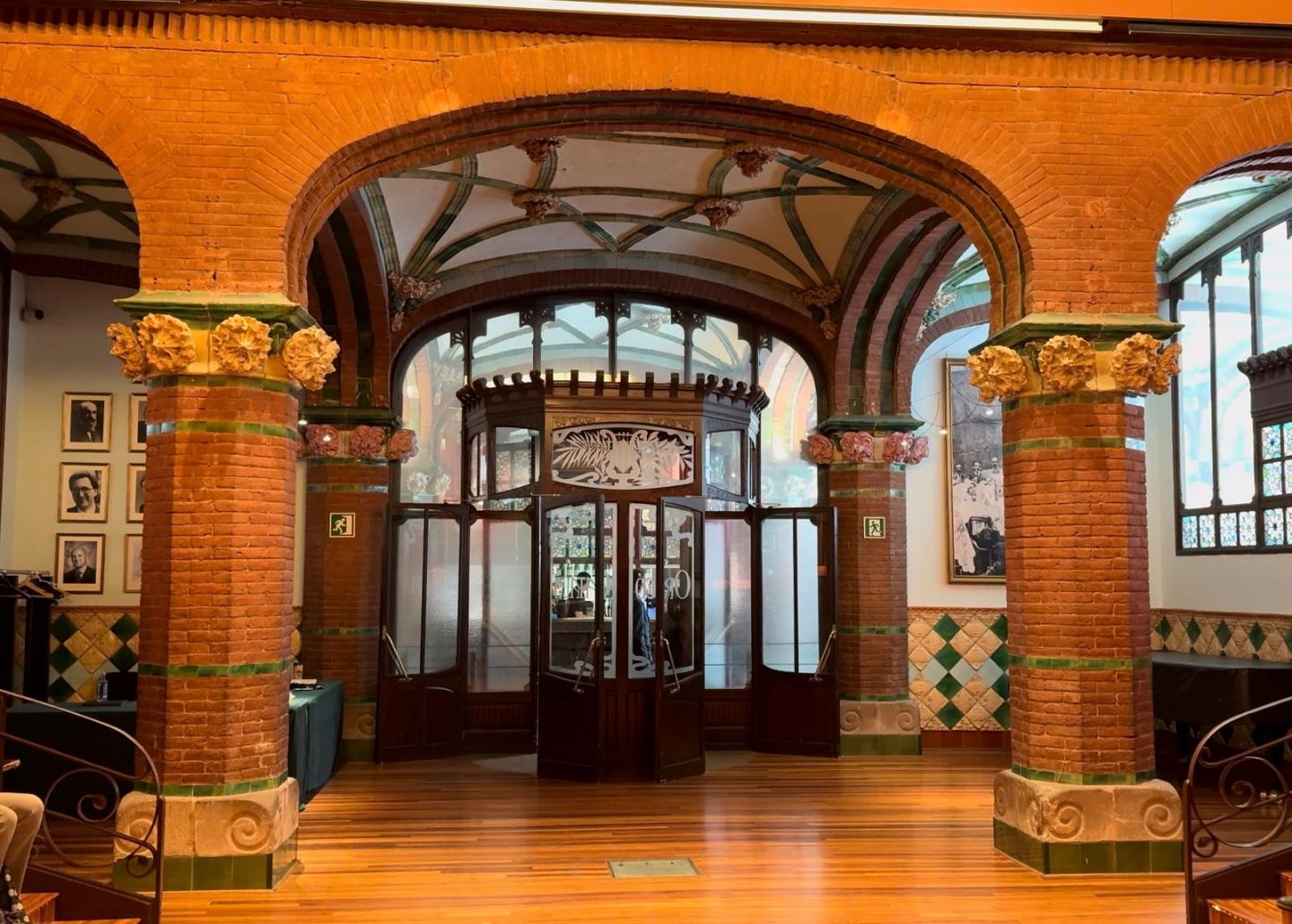
The frame around the stage is a sculptural group by Pau Gargallo. Outside, on the first-floor corner of the building, there’s a large sculptural ensemble by Miquel Blay with mosaic by Lluís Bru — and it’s free to look at. Stand on the corner and look up before you go in, or after you come out; most visitors walk straight past the best thing on the exterior.

Is the Palau de la Música good with children?
Yes, with two caveats and one strong argument in favour.
In favour: it’s free under 10, it’s only 50 minutes, and the skylight is the sort of thing that makes a child’s mouth open. The eighteen muses coming out of the wall hold attention better than any facade.
The caveats:
- It’s a talk in a room. There’s nothing to climb on, touch or do. Older children get more from it — say seven upwards, and teenagers who like art or music get a lot
- Bring a small bag. Large bags and suitcases are not permitted and there is no cloakroom on the visit route, which catches out families arriving with a day’s worth of things. (There is a cloakroom in the Petit Palau lobby, for concerts.)
Practical notes: guided tours run in several languages depending on the day, so check when booking. The building is accessible — lifts on all floors, adapted toilets, and a wheelchair loan service on request — and there’s a café-restaurant in the Foyer if you need somewhere to sit afterwards.
And a rule I enjoyed finding in the small print: you may not take a guided tour in a wedding dress. Photo shoots have to be arranged in advance.


Getting there
- Address: Carrer del Palau de la Música, 4–6 (the entrance side is Carrer Sant Pere més Alt, 4)
- Metro: Urquinaona — L1 (red) and L4 (yellow)
- On foot: five minutes from Plaça Catalunya
- Train: Renfe and FGC both at Plaça Catalunya
- Hop-on hop-off: the tourist bus routes stop within walking distance
- Accessible parking: spaces for people with reduced mobility on Carrer d’Ortigosa and Carrer Sant Pere Més Baix
A T-familiar is the ticket you want if there are several of you — it’s shareable, unlike the T-casual.
Pair it with Sant Pau — they’re the same UNESCO listing
Here’s the thing almost nobody realises. The UNESCO World Heritage property is not called “Palau de la Música Catalana”. It’s called “Palau de la Música Catalana and Hospital de Sant Pau, Barcelona”, inscribed in 1997 — one listing, two buildings, both by Domènech i Montaner.
So if you visit one, you have seen half of a World Heritage Site.
Sant Pau is the other half, and it’s the better-value of the two — an entire complex of pavilions and gardens, and free under 12. Doing both in one trip is the single best Modernisme decision available in Barcelona, and it costs less than one Sagrada Família ticket each.
If you like Domènech i Montaner, the third one is Casa Thomas on Carrer de Mallorca, which he built for a printer in 1895–98 — you can’t normally go in, but it opens during 48h Open House Barcelona each October, and it’s free.
A short history, because it explains the building
Domènech i Montaner was commissioned in 1905 to build a headquarters for the Orfeó Català — a choral society, founded by and for ordinary people who sang. Not a royal opera house, not an aristocratic commission: a building for a choir.
It was built between 1904 and 1908 and inaugurated on 15 February 1908. The Orfeó Català is still based there and still performs.
That origin explains the whole building. The exuberance isn’t grandeur for its own sake — it’s a civic society spending everything it had on a home for Catalan music at a moment when Catalan culture was asserting itself. The brick facade with its stone and ceramic work, the muses, the skylight: Domènech treated ornament not as decoration added at the end but, in his own approach, as the thing that completes the architecture.
Is it worth it?
Yes — and of Barcelona’s big-ticket Modernisme, it’s the one I’d defend hardest.
€24 is not cheap. But the Sagrada Família is €26 to €40 and you share it with thousands; Casa Batlló is around €35. The Palau is a working concert hall that lets you in for 50 minutes in the morning, and the room at the top of it is better than anything you will see on the other tours.
Go in the morning, book online, take the children free, and look up.
More Barcelona: the 25 places worth your time · 50 free things to do · Barcelona with kids
We first visited on a guided tour through a collaboration with MegaPass. Prices, opening hours and access details above were checked against palaumusica.cat in September 2026 — always confirm on the official site before you travel.

🎟 Get your MegaPass here:
🔗 Barcelona City Pass | Most Popular Attractions | Picasso Museum | Cathedral of Barcelona

- Available
- Ticket
- Tour
- Best Selling Tour
Frequently asked questions
How much does it cost to visit the Palau de la Música Catalana?
A guided tour is €24 and a self-guided visit with a brochure is €20. Over-65s and under-35s pay €20, people with a disability below 65% pay €12, and residents in Catalonia pay €14. Children under 10 accompanied by an adult go free. Buying at the box office adds €2 per ticket, so book online.
Are children free at the Palau de la Música Catalana?
Yes. Children under 10 accompanied by an adult go free, which the ticket resale sites rarely make clear. You still need to include them when you book so they have a place in the group. For a family of four with two young children that is the difference between €48 and €96.
What are the opening hours of the Palau de la Música Catalana?
Visits run from 09:00 to 15:30 every day. This is a working concert hall, so the building is handed over to rehearsals and performances in the afternoon and the visiting window closes at half past three — much earlier than most Barcelona attractions. Plan it as a morning.
How long is the guided tour?
About 50 minutes. Guided tours are available in several languages depending on the day and the schedule, so check when you book.
Should you take the guided tour or the self-guided visit?
The guided tour costs €4 more and is worth it on a first visit, because almost everything in the building is symbolic and very little of it is self-evident. The self-guided visit shows you the same concert hall and suits anyone who would rather move at their own pace — including families with young children, whose patience for a 50-minute talk is limited.
Can you visit the Palau de la Música Catalana with kids?
Yes, and under-10s are free. It works best from about age seven, because it is essentially a talk in a beautiful room with nothing to touch or climb on. The stained-glass skylight and the eighteen muses emerging from the stage wall are the two things children respond to. Note that large bags and suitcases are not permitted and there is no cloakroom on the visit route.
Is the Palau de la Música Catalana a UNESCO site?
Yes, inscribed in 1997 — but not on its own. The World Heritage property is called “Palau de la Música Catalana and Hospital de Sant Pau, Barcelona”: one listing covering two buildings, both by Lluís Domènech i Montaner. Visiting one means you have seen half of it.
Is the Palau de la Música Catalana worth visiting?
Yes, and it is the best value of Barcelona’s major Modernisme attractions. At €24 it is cheaper than the Sagrada Família or Casa Batlló, it takes only 50 minutes, children under 10 are free, and the concert hall with its inverted stained-glass skylight is the most extraordinary interior in the city.
How do you get to the Palau de la Música Catalana?
Metro Urquinaona on L1 (red) and L4 (yellow), or a five-minute walk from Plaça Catalunya. The address is Carrer del Palau de la Música 4–6, with the entrance on Carrer Sant Pere més Alt.

1 Comment