
We spent 19 days in Japan as a family of four in July 2023 — Tokyo, Nikko, Osaka, Nara, Uji, Kyoto and Kurashiki. This is what we actually paid.
It’s also, unintentionally, a before-and-after. We bought our rail passes about two months before Japan raised the price of the JR Pass by roughly 69%, the biggest increase in its history, and several of the things we paid to get into have gone up sharply since. So alongside what we spent, I’ve put what the identical trip costs today.
The headline
- Flights were the biggest cost by far: €2,600 for four, Barcelona to Tokyo.
- Eight nights of hotels came to about €650 — roughly €81 a night for a family of four in Tokyo and Kyoto.
- Our four 14-day JR Passes cost a little over €1,000. The same four passes today cost ¥240,000, and ¥252,000 from 1 October 2026.
- Universal Studios was around €160 for the four of us — the single biggest activity cost of the trip.
- Almost everything we remember was free: Fushimi Inari, the bamboo grove, Meiji Shrine, the old town after dark.
All figures are what we paid in July 2023. Japanese prices and the exchange rate have both moved a lot since — that’s what the second half of this article is about.
Where we stayed in Japan
The B Ochanomizu – central Tokyo, next to Ochanomizu station on the JR Chuo line.
Sakura Cross Hotel Kyoto Kiyomizu – under 2 km from Kiyomizu-dera and the old town. A compact room for four, but a good choice if location and budget matter more than space.
Affiliate links: if you book through them we may earn a small commission, at no extra cost to you. In Osaka we stayed with family.
Flights: a third of the trip before we left Barcelona
€2,600 for four people, Barcelona to Tokyo via Rome with ITA Airways, in economy.
That’s the number that decides whether Japan happens for a family, and there is no clever way around it. My advice to anyone budgeting: price the flights first and treat everything else as the variable. If the flights don’t work, cheap hotels won’t rescue the trip. ITA Airways Barcelona to Tokyo review
The JR Pass: we got lucky on timing
We bought four 14-day passes — two adult, two child — from Barcelona, for a little over €1,000. They arrived within 48 hours.
Two months later, on 1 October 2023, Japan raised JR Pass prices by around 69%. A 14-day adult pass went from ¥47,250 to ¥80,000. We did not plan that; we were simply travelling before it happened.
What that means if you’re planning now: four 14-day passes for two adults and two children cost ¥240,000 today — and rise again to ¥252,000 on 1 October 2026 for passes bought through overseas agencies. Buying before that date fixes the current price. Is the JR Pass worth it?
The saving that is repeatable is the one we made ourselves: we didn’t activate the pass when we landed. Our Tokyo days ran entirely on the metro, which the JR Pass doesn’t cover, so the pass would have been burning days for nothing. We started it when we began moving between cities. On a 19-day trip that let us buy 14 days instead of 21 — across four people, that’s a whole pass length saved.
Accommodation: €650 for eight nights, and eleven nights free
This is where our trip stops being typical, so I’ll be straight about it.
- Tokyo — The B Ochanomizu, 4 nights: around €400. Central, three minutes by metro from Tokyo Station. The B Ochanomizu hotel review
- Kyoto — Sakura Cross Hotel Kiyomizu, 4 nights: around €250. Under 2 km from the old town, and the reason we could walk Higashiyama twice in one day. Sakura Cross Hotel Kyoto Kiyomizu review
- Osaka — my brother-in-law’s apartment: nothing. He lived there. We stayed with family.
So eight paid nights at roughly €81 a night for four people, and the rest of the trip housed for free. If you’re using this to budget, add your own Osaka accommodation — for a family, somewhere in Namba or Umeda is going to be in the same range as the Tokyo and Kyoto figures above.
What the two paid hotels have in common is that both were compact three-star city hotels, spotlessly clean, and cheap enough that we could stay four nights instead of two. That trade — more nights, smaller room, right neighbourhood — is the one I’d make again every time.

What we paid to get into things
Japan is unusual in how much of the good stuff costs nothing. Fushimi Inari, the Arashiyama Bamboo Grove, Meiji Shrine, Osaka Castle Park, Shibuya Crossing, the whole of Higashiyama — free, all of it.
What we actually paid for:
- Universal Studios Japan — around €160 for four. Bought on the day, at the park. Comfortably the biggest single activity cost of the trip. Universal Studios Japan with kids
- teamLab, Tokyo — booked before we flew, which is not optional; slots sell out.
- Osaka Castle tower — ¥600 for an adult, and children under 15 went in free. Osaka Castle with kids
- Kinkaku-ji — ¥500 an adult, ¥300 for primary and middle school children, cash at the gate. Kinkaku-ji, the Golden Pavilion
- Round1 Osaka — pay-per-play arcade, roughly ¥100 a go, across two visits. Round1 Osaka
If you need to bring a Japan trip down, this is the flexible category. The temples are close to free. The theme park is not.
Food: the part I can’t give you a number for
I’m not going to invent one.
We didn’t track food. Some of it was cash, some card, a lot of it was konbini breakfasts and things bought standing up, and there is no total I could reconstruct honestly three years later. Most cost-breakdown posts you’ll read do have a food figure, and I’d gently suggest that a good share of those are estimates presented as receipts.
What I can tell you is the shape of it, which is more useful anyway:
- Conveyor-belt sushi is the cheapest good family meal in Japan. You pay per plate, the children choose their own, and your stack of plates is the bill — so you can see the number building as you eat. Kura Sushi Binario Umeda
- Ramen is fast and cheap, and a chain is genuinely easier on day one than hunting for an independent. Ippudo ramen in Osaka
- Konbini food is good. Not a compromise — actually good. Breakfast from a 7-Eleven is normal, not a sacrifice.
- Water is free and arrives iced, at every table, without asking.
Japan is one of the few expensive-seeming countries where eating cheaply doesn’t feel like a downgrade, and that is a real part of why the trip worked financially.

The costs nobody warns you about
- City transport. The JR Pass covers nothing inside Tokyo, Osaka or Kyoto. You need IC cards — Suica, Pasmo or ICOCA — on top, for four people, for the whole trip.
- A data SIM. We bought a 31-day data-only SIM at the airport. Navigating the rail network without live maps is much harder than it needs to be.
- Cash. Not a cost, but a constraint. Kinkaku-ji is cash-only at the gate, and so are plenty of small restaurants and shops.
- Coin lockers. A few hundred yen each time, and you’ll use them more than you expect.
What the same trip costs now
This is the part that surprised me when I sat down to write it.
| Item | What we paid, July 2023 | Now |
|---|---|---|
| JR Pass, 14-day adult | ¥47,250 | ¥80,000 (¥84,000 from 1 Oct 2026) |
| JR Pass, 14-day child | ~¥23,620 | ¥40,000 (¥42,000 from 1 Oct 2026) |
| Four passes, 2 adults + 2 children | ~¥141,740 | ¥240,000 (¥252,000 from 1 Oct 2026) |
| Osaka Castle, adult | ¥600 | Revised upward on 1 April 2025 — check the official site |
| Kinkaku-ji, adult | ¥500 | ¥500 — unchanged |
The rail pass is the one that hurts. Our four passes would cost roughly 70% more today than they did in July 2023, and more again after 1 October 2026.
Osaka Castle raised its admission in April 2025, so the ¥600 we paid is history — check the current figure before you go, because a lot of guides still quote the old one.
Kinkaku-ji, for what it’s worth, hasn’t moved at all. Some things in Japan stay exactly where they are.
So is Japan expensive with kids?
Less than we expected in 2023, and still less than its reputation suggests in 2026 — but the gap has narrowed, and almost all of the narrowing is the rail pass.
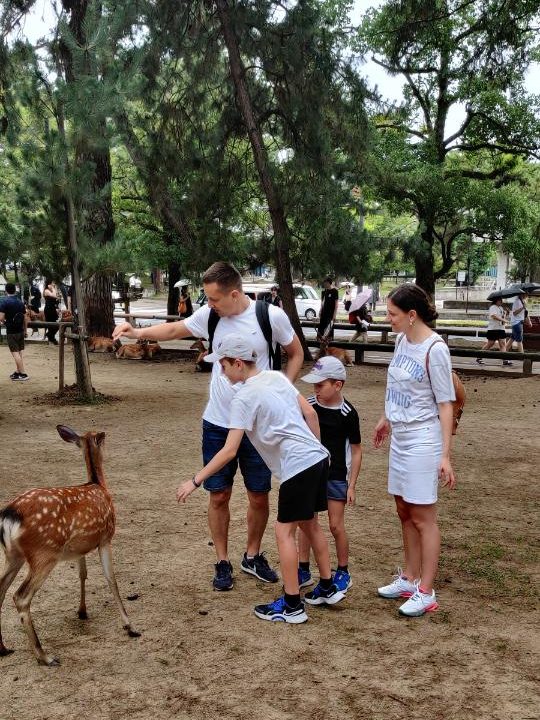
The honest structure of a Japan family budget looks like this: flights are the barrier, the rail pass is the second barrier and has got significantly worse, accommodation is good value if you accept small rooms, and food and attractions are genuinely cheap. An enormous share of what your children will actually remember — deer in Nara, monkeys in Arashiyama, empty torii gates at dawn, a lantern-lit street at night — costs nothing at all.
What I’d tell you to do with this
- Price the flights first. Everything else is negotiable; that isn’t.
- Do the rail pass maths properly, and don’t assume you need it. If you’re staying in one region, a regional pass is far cheaper.
- Don’t activate the pass on arrival. The single most repeatable saving we made.
- Stay longer in fewer places. Cheap hotels bought us four nights in Kyoto instead of two, and that’s what made Kyoto work.
- Budget for the theme park and treat the temples as free. Because they nearly are.
The whole trip, guide by guide
Every post from these 19 days, in one place: Japan with Kids — our 19-day trip
Planning your own? If you’re going within the next few months, the JR Pass price rise on 1 October 2026 is worth knowing about before you book.
This page contains affiliate links. If you book through them we may earn a small commission at no extra cost to you. We paid for everything on this trip ourselves.
Frequently asked questions about the cost of Japan with kids
How much does a trip to Japan cost for a family of four?
Our 19 days in July 2023 cost €2,600 in flights, a little over €1,000 for four 14-day JR Passes, and about €650 for eight nights of hotels in Tokyo and Kyoto. We stayed with family in Osaka, so our accommodation total is lower than most people’s. Flights are the single figure that decides whether Japan is possible for a family.
How much has the JR Pass gone up?
A lot. We paid ¥47,250 for a 14-day adult pass in July 2023; the same pass is ¥80,000 today and rises to ¥84,000 on 1 October 2026 for passes bought through overseas agencies. Across two adults and two children that is roughly ¥141,740 then against ¥240,000 now — about 70% more.
Is Japan expensive with children?
Less than its reputation suggests, though the gap has narrowed since 2023 and almost all of that is the rail pass. Accommodation is good value if you accept compact rooms, cheap food is genuinely good rather than a compromise, and a large share of what children remember — the deer in Nara, the monkeys in Arashiyama, the torii gates at Fushimi Inari, the old town after dark — is free.
What is the biggest cost of a Japan trip?
Flights, by a distance, if you are travelling from Europe with a family. Ours were €2,600 for four, about a third of the trip before we left home. After that it is the rail pass and accommodation, in that order.
How much are attractions in Japan?
Far less than most destinations, because so much is free. Fushimi Inari, the Arashiyama Bamboo Grove, Meiji Shrine and Osaka Castle Park all cost nothing. Kinkaku-ji is ¥500 for adults and ¥300 for primary and middle school children, cash at the gate, and has not changed price since 2023. The cost that actually matters is the theme park: Universal Studios Japan was around €160 for the four of us.
Do you need a JR Pass for a family trip to Japan?
Only if you are moving between several cities. It covers nothing inside Tokyo, Osaka or Kyoto, so you also need IC cards for local transport. The most useful saving is not buying the pass but timing it — we spent our Tokyo days without it and only activated it when we started travelling between cities, which let us buy a 14-day pass on a 19-day trip.
