
Japan in July with Kids: The Heat, the Festivals and How to Re-Time Your Trip
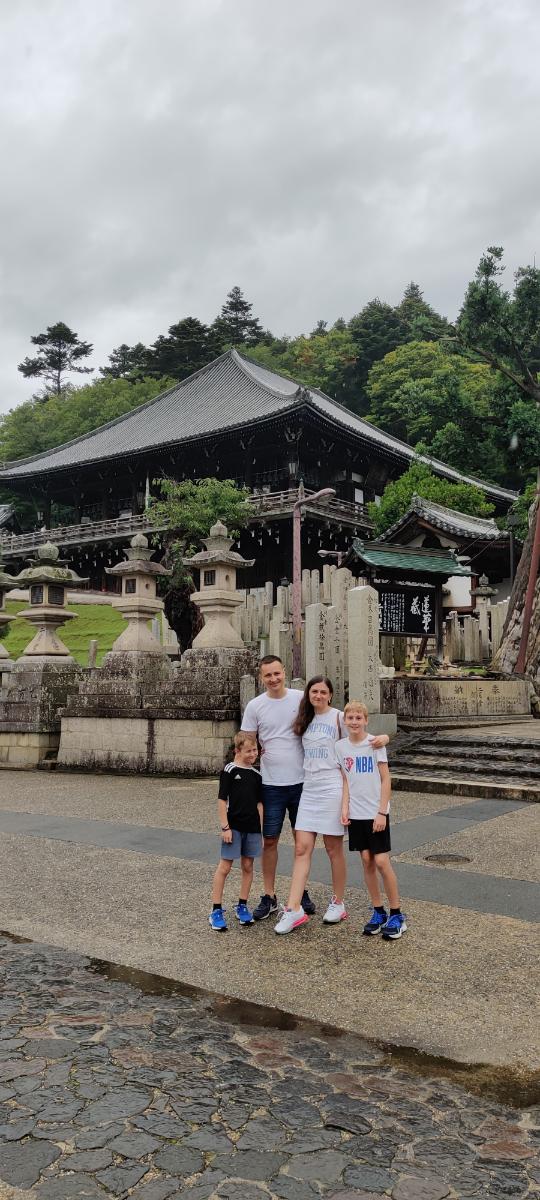
We took our two children to Japan in mid-July. Tokyo, Kyoto, Osaka, nineteen days, in the month most guidebooks describe as “warm and humid” and everyone who has actually done it describes differently.
Here is the honest version. July is the hardest month to travel Japan with children, and it has the best festivals in the Japanese calendar. Both of those things are true at once, and the trip works if you accept the first in order to get the second.
Where We Stayed in Japan
Two hotels across nineteen days — in Osaka we stayed with family, so there’s nothing to recommend there.
The B Ochanomizu
JR Chuo–Sobu line, between Akihabara and the university district. Quiet at night, quick to leave in the morning.
Check pricesSakura Cross Hotel Kyoto Kiyomizu
Walking distance to Higashiyama. The location did more for our Kyoto days than any facility would have.
Check pricesAffiliate links — we earn a small commission at no extra cost to you. We’ve only listed the two places we actually stayed.
The short version
- Kyoto and Osaka average around 33°C in July; Tokyo around 30°C. Humidity runs 75–85%.
- The rainy season ends mid-to-late July across central Honshu — so the first half of the month is wetter and the second half is hotter.
- Nothing comes off the itinerary. Everything gets re-timed. Outdoors before 11:00, indoors 11:00–16:00, outdoors again after 17:00.
- The festivals are the payoff: Gion Matsuri in Kyoto through July with its parade on the 17th, Tenjin Matsuri in Osaka on 24–25 July, and the big Tokyo fireworks in late July.
- Heat stroke is a genuine risk, not a caution. Japan takes netchūshō seriously and so should you.
What the weather is actually like
| City | Average high | Average low |
|---|---|---|
| Tokyo | 30°C | 23°C |
| Kyoto | 33°C | 24°C |
| Osaka | 33°C | 25°C |
Those numbers understate it, because the number that matters is the humidity: 75 to 85 per cent. Thirty-three degrees in Barcelona in August and thirty-three degrees in Kyoto in July are not the same experience. Sweat does not evaporate. You are damp from about nine in the morning until you get back to the hotel.
Kyoto is the hard one. It sits in a basin ringed by mountains, which traps the heat and kills the breeze. If your itinerary has a heavy Kyoto block — ours did — that is the part to plan most carefully.
Still deciding where to base yourself? See where to stay in Kyoto with kids.

The rainy season splits the month in half
Japan’s rainy season, tsuyu, typically ends in mid-to-late July across central Honshu. This matters more than the average temperature does, because it means the first half of July and the second half of July are two different trips:
- Early July — more rain, slightly lower temperatures, greener, fewer people, higher chance of a washed-out day.
- Late July — the rain stops, the heat arrives properly, and the festival calendar peaks.
If you have a choice and you are bringing children, we would take early July — an hour of rain is easier to manage than an afternoon at 35°C, and a wet temple is still a temple.
How we’d re-time the whole trip
This is the part that actually matters, and it is the thing no guide says plainly: you do not cut things from a July itinerary. You move them.
Before 11:00 — everything outdoors
Shrines, gardens, walks, climbs, anything with a queue. All of it happens in the morning or it doesn’t happen well.
This is doubly true of anything uphill. Arashiyama Monkey Park is a 20-to-30 minute climb — fine at 9:00, genuinely unpleasant at 14:00. Fushimi Inari is the same problem with more steps, and it has the advantage of being open around the clock, so it is the one place where “go at dawn” is literally possible. The bamboo grove is shaded but it is also the single most crowded 500 metres in Kyoto by mid-morning.

11:00 to 16:00 — indoors, deliberately
This is the block people get wrong. They treat the middle of the day as prime sightseeing time because it is at home. In July in Japan it is the block you spend in air conditioning, and the good news is that Japan is exceptionally well equipped for this.
- Underground shopping cities. Osaka’s underground — Namba Walk, Whity Umeda, Crysta Nagahori — is kilometres of air-conditioned walkway with food and shops, and in July it stops being a shopping trip and becomes infrastructure.
- Department store food halls. Cold, free to walk through, and the basement food floors are more interesting to children than any museum.
- Indoor attractions. teamLab Planets has you walking through knee-deep water in a dark building, which in July is close to therapeutic. Round1 is an entire building of air-conditioned sport.
- Trains. Do not underestimate this. A JR Pass turns every intercity leg into two hours of cold air and a seat, which is why moving cities on the hottest day is not the bad idea it sounds like.
After 17:00 — back outside
The temperature drops, the lanterns come on, and this is when Japanese cities in summer are at their best. Dotonbori, the river fronts, the festival evenings. Children who have been indoors from midday have the reserves for it.
This means a later bedtime for the whole trip, and it is worth it. Fighting for a normal bedtime in July costs you the best three hours of the day.
The festivals, which are the actual reason to come in July
July is the single best festival month in the Japanese calendar, and the big three all fall in the second half.
Gion Matsuri, Kyoto — all month, peaks 17 and 24 July
Kyoto’s Gion Matsuri runs across the whole of July, and its centrepiece is the Yamahoko Junko float parade on 17 July, with a second parade on the 24th. The enormous wooden floats are built in the streets in the days beforehand, which for children is arguably better than the parade itself — you can walk up to them, watch them being assembled, and in some cases go inside.
The evenings before the parade (yoiyama) close the central streets to traffic and fill them with food stalls. It is crowded and it is hot and it is one of the great things you can show a child.
Tenjin Matsuri, Osaka — 24 and 25 July
Osaka’s own, and one of Japan’s three biggest festivals: a procession of boats down the river on the evening of the 25th, with fireworks over the water. Less hot than a daytime festival by definition, and the boats give children something to actually watch.
Tokyo fireworks — late July
The Sumida River fireworks in late July put more than twenty thousand fireworks over the river in front of something approaching a million people. Take the crowd size seriously with small children; there are quieter vantage points and the riverbank is not one of them.
What we’d actually pack differently
Not a packing list — the things specific to this month.
- More changes of clothes than the trip length suggests. You will change in the middle of the day. Hotel laundry becomes part of the routine rather than an emergency.
- A cooling towel each. The Japanese ones you wet and snap are sold in every convenience store and they work.
- A hand fan per person. Not a gimmick. Everyone around you has one.
- Electrolytes, not just water. Pocari Sweat and Aquarius are in every vending machine and are the standard Japanese answer to summer heat. Plain water at that humidity is not enough for a child who has been walking.
- Sun hats that will actually stay on.
- Shoes that dry. Between the rain at the start of the month and the sweat at the end, one pair of trainers is not enough.
- Cash. Unrelated to the heat, but the places that are cash-only tend to be the small outdoor ones — the monkey park, festival food stalls, small shrines.
Heat stroke: the part to take seriously
Japan treats netchūshō — heat stroke — as a public health issue, with televised warnings and public cooling rooms. Children are more vulnerable than adults because they heat up faster and are worse at noticing it.
The practical version: drink before anyone is thirsty, take the electrolyte drinks rather than only water, go indoors on a schedule rather than when someone complains, and treat a child who has gone quiet as a warning rather than a relief.
This is not a reason to avoid July. It is a reason to build the day around it.
So is July a good time to take kids to Japan?
It is a fair trade, not a bargain.
What you get: the festival calendar at its peak, school holidays that line up for most of Europe, long evenings, and — genuinely — a version of Japan that feels alive in a way the cherry-blossom crowds don’t quite capture.
What you pay: the middle of every day, and a certain amount of goodwill from children who are hot.
Would we go in July again? With the itinerary re-timed the way it is described above, yes. Going in July and trying to run a normal itinerary, no — and that, more than the weather, is what makes people say July was a mistake.
If you are putting a summer trip together, our full Japan itinerary with kids is the day-by-day version, and what the whole trip cost us has the numbers.
Still deciding where to base yourself? See where to stay in Kyoto with kids, or check prices in Higashiyama →
Frequently asked questions about visiting Japan in July with kids
How hot is Japan in July?
Kyoto and Osaka average around 33°C in July and Tokyo around 30°C, with humidity between 75 and 85 per cent. The humidity is what makes it hard rather than the temperature — sweat does not evaporate, so it feels considerably hotter than the same reading in a dry climate. Kyoto sits in a basin ringed by mountains and is the hottest of the three.
When does the rainy season end in Japan?
The rainy season, tsuyu, typically ends in mid-to-late July across central Honshu. That splits the month into two different trips: early July is wetter and slightly cooler, while late July is drier, hotter and busier with festivals.
Is July a good time to visit Japan with children?
It is a fair trade rather than an easy month. You get the best festival calendar of the year and long evenings, and you pay for it with the middle of every day. It works if you re-time the itinerary — outdoors before 11:00, indoors from 11:00 to 16:00, and outdoors again after 17:00 — and it goes badly if you try to run a normal schedule.
What festivals are on in Japan in July?
Gion Matsuri runs through the whole of July in Kyoto, with its main Yamahoko Junko float parade on 17 July and a second parade on 24 July. Tenjin Matsuri in Osaka is on 24 and 25 July and includes a boat procession and fireworks on the river. Tokyo’s Sumida River fireworks are in late July.
What should you pack for Japan in July with kids?
More changes of clothes than the trip length suggests, a cooling towel and a hand fan for each person, electrolyte drinks rather than only water, sun hats that stay on, and shoes that dry. Cooling towels, fans and drinks like Pocari Sweat are all available in any Japanese convenience store, so they can be bought on arrival rather than carried.
How do you avoid heat stroke in Japan with children?
Drink before anyone is thirsty, use electrolyte drinks rather than plain water, and move indoors on a fixed schedule rather than waiting for someone to complain. Children heat up faster than adults and are worse at noticing it, so a child who has gone quiet should be treated as a warning sign rather than a relief.
