
You take your shoes and socks off at the door, and at some point you walk through water up to your knees. That’s the part nobody quite prepares you for, and it’s why teamLab Planets works so well with children.
We went on our first day in Tokyo, straight from the airport, with our suitcases still with us. Here’s what actually happens, what to wear, and what to do about the luggage if you make the same mistake we did.
The short version
- It’s barefoot. Shoes, socks and tights all come off. This isn’t optional.
- You walk through water — up to knee height for an adult, so higher on a child.
- Don’t wear a skirt. Several floors are mirrored. Free rental shorts are available if you forget.
- Allow 2 to 2.5 hours for all the artworks.
- Tickets: from around ¥3,600 for adults, ¥1,500 for children aged 4–12, free under 3. Dynamic pricing, booked online in advance.
- Where: Toyosu — one minute from Shin-Toyosu station on the Yurikamome line.
We visited in July 2023. teamLab adds and changes artworks regularly, so the individual rooms may differ from what we saw — the format doesn’t.
Where to stay in Tokyo with kids
The B Ochanomizu – our base for four nights with a 10- and a 7-year-old. On the JR Chuo–Sobu line, quiet at night and quick to leave in the morning.
Mimaru Tokyo Ueno East – apartment-style rooms with a kitchen and separate living area, near Ueno park and the museums. Solves the real Tokyo problem: a standard room for four is very small.
Grand Hyatt Tokyo, Roppongi – spacious suites, several restaurants and an indoor pool, which after three days of walking Tokyo in the heat is the facility that earns its money.
We stayed at The B Ochanomizu. The other two are the ones we’d book, chosen on room capacity and location rather than from a stay of our own. Affiliate links — we may earn a small commission at no extra cost to you.

Planets or Borderless? They’re different museums
This trips up a lot of people, and it’s worth two minutes before you book.
- teamLab Planets is in Toyosu. You go barefoot, you walk through water, and there’s a set route through the artworks. This is the one we visited.
- teamLab Borderless is in Azabudai Hills, in central Tokyo. Shoes stay on, and the rooms flow into each other with no set route — you wander and get lost on purpose.
They’re in completely different parts of the city, so if you book the wrong one you’ll find out at the wrong station.
One piece of history that catches people out: Borderless used to be in Odaiba, closed there in August 2022, and didn’t reopen at Azabudai until February 2024. Plenty of older articles still point at the Odaiba site. If you’re reading a guide, check when it was written.
With young children specifically, the barefoot-and-water format at Planets is either exactly right or exactly wrong, and you’ll know which for your own child. Ours loved it. If yours dislikes wet clothes and unfamiliar textures underfoot, Borderless is the safer booking.
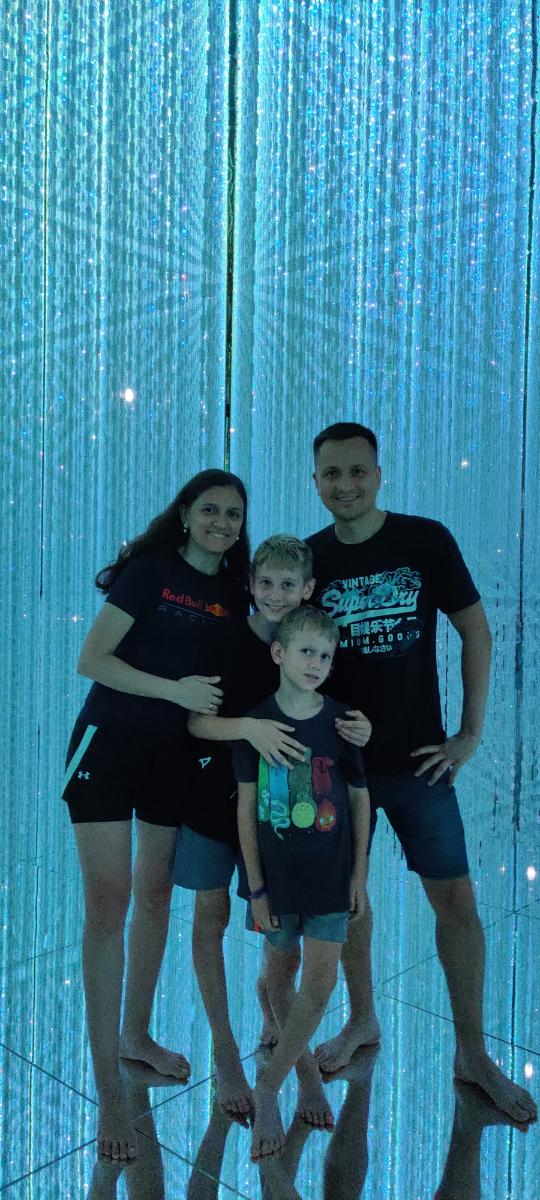

Going straight from the airport — learn from us
We landed at Narita, spent longer at the airport than planned, and went directly to teamLab rather than lose our timed slot. With the bags.
Here’s the thing I’d want to have known: the free lockers are small. Roughly 23 × 34 × 37 cm — fine for a bag, not for a suitcase. Larger luggage has to be left in the designated area with a wire lock rather than locked away.
So if you’re doing the same thing, plan for it. Either use coin lockers at a station on the way, or use a luggage forwarding service to your hotel, or accept that your suitcase sits in an open area for a couple of hours. It’s Japan, and it was fine, but it’s not the way I’d choose to start a trip again.
We left our luggages close to lockers, straight before entering the teamLab.
What to wear
This matters more here than at any museum I’ve been to.
- Trousers you can roll above the knee. The water reaches knee height on an adult, and it will be higher on a child. Jeans are a bad idea — they don’t roll and they don’t dry.
- Not a skirt or a dress. Several floors are mirrored, which means exactly what you think it means. The museum is direct about this. If you turn up in one, there are free rental shorts in sizes XS to 6L.
- Bare feet throughout. Shoes, socks and tights go in a locker.
- A small towel isn’t provided as far as I remember, and your legs will be wet.
For children: shorts, or leggings that roll up easily. Something that dries fast, because they will get wetter than you do.
What it’s like barefoot, with kids
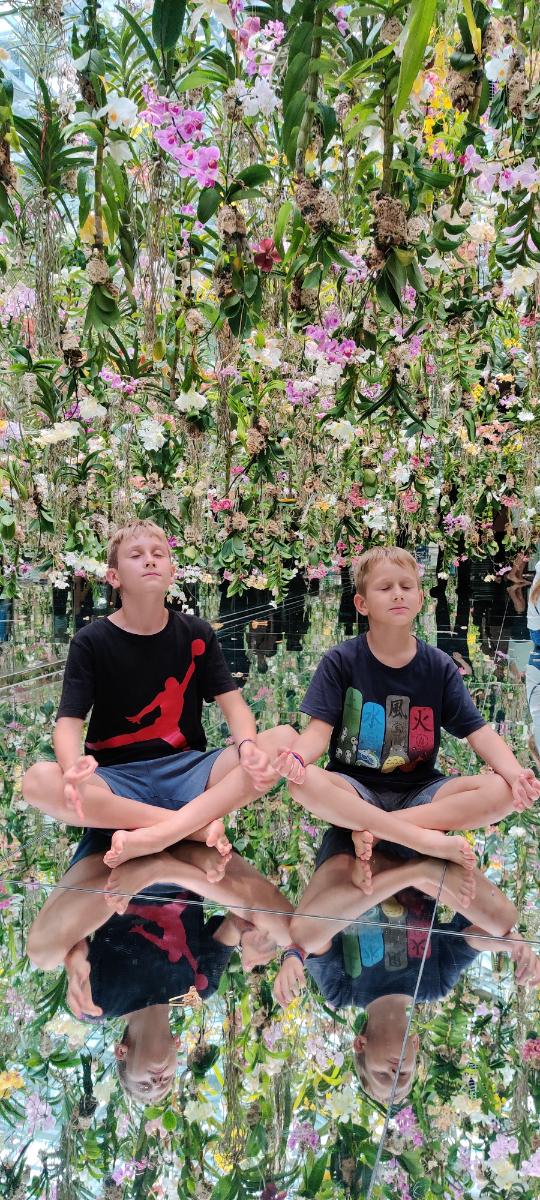
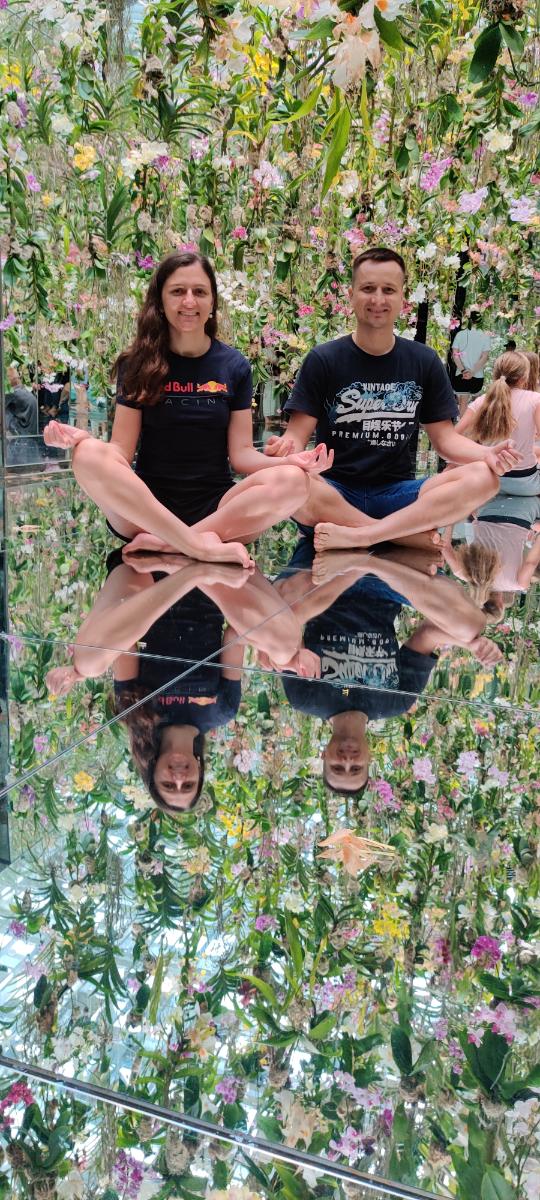
The barefoot thing is the whole experience rather than a rule you put up with. The floors change texture as you move through — soft, hard, sloping, wet — and you notice it in a way you simply don’t in shoes.
Then you walk into the water. It’s warm, it’s up to your knees, and there are koi projected onto the surface that scatter when you move through them. Our two were completely taken with it.
What this format gives you that a normal museum doesn’t: nobody is telling your children to be careful. Nothing is behind glass, nothing breaks, and the whole point is to walk into things. After a long-haul flight with two children, that was worth a great deal.

Tickets and booking
Tickets are sold online with timed entry and use dynamic pricing, so the same slot costs different amounts on different days. Broadly: from around ¥3,600 for an adult, ¥1,500 for children aged 4 to 12, ¥2,800 for junior and senior high students, and free for under-3s.
Tickets go on sale roughly three months ahead. Book before you fly — we booked well in advance and by the time we went, the slots around ours had gone. This is not somewhere you decide to visit on the morning.
Prices checked September 2026. Confirm current rates on the official site before booking.
Getting there
- Shin-Toyosu station on the Yurikamome line — about a minute on foot from the north exit. This is the easy one.
- Toyosu station on the Tokyo Metro Yurakucho line — about a ten-minute walk from exit 7.
Address: 6-1-16 Toyosu, Koto-ku, Tokyo.
Toyosu is east of central Tokyo and it is not on the way to anything else you’re likely to be doing, so treat this as its own trip rather than something to slot between two other stops.
How long you need
Two to two and a half hours covers the artworks properly. Add time for the lockers, getting shoes off and on, and drying feet at the end.
Last admission is an hour before closing, which is worth knowing if you’re planning an evening slot — an hour is not enough to see it.
With children, by age
- Under 3: free, and the water areas are manageable if you’re happy to carry them through. Strollers are not allowed inside — there’s parking outside with wire locks, so bring a carrier if you need one.
- 4 to 12: the sweet spot, and the age bracket with its own ticket price. Ours were in this range and it was the best thing we did in Tokyo.
- Teenagers: works, and it photographs extremely well, which at that age is not a small thing.
Is teamLab Planets worth it?
Yes, and it’s the one Tokyo attraction I’d book before anything else with children.
It’s not cheap for a family, and Toyosu is a trek. But it’s genuinely unlike anything else — a museum where the instruction is to walk into the art barefoot rather than stand back from it — and it’s the rare paid attraction where children get more out of it than adults do.
The only people I’d steer away: families with a child who really dislikes being wet or barefoot on unfamiliar surfaces. For them, Borderless does the same trick with shoes on.
Where it fits in a Tokyo trip
It’s a half-day once you’ve accounted for the journey out to Toyosu, and because entry is timed it’s the thing you build the day around rather than slot in. We used it as the opening of our Tokyo days. 4 Days in Tokyo with Kids
- The B Ochanomizu Tokyo hotel review
- Starbucks Reserve Roastery Tokyo
- Nikko day trip from Tokyo
- ITA Airways Barcelona to Tokyo review
- Japan with Kids — our 19-day trip
Book ahead. Timed slots and dynamic pricing mean the good times and the cheaper days both go early.
This page contains affiliate links. If you book through them we may earn a small commission at no extra cost to you. We paid for our own tickets.
Frequently asked questions about teamLab Planets
What is the difference between teamLab Planets and teamLab Borderless?
They are separate museums in different parts of Tokyo. Planets, in Toyosu, is walked barefoot and includes areas where you wade through water up to knee height, along a set route. Borderless, in Azabudai Hills, is walked with shoes on and has no fixed route — the rooms flow into one another. Borderless was previously in Odaiba, where it closed in August 2022, and did not reopen at Azabudai until February 2024, so older guides pointing to Odaiba are out of date.
Do you really have to go barefoot at teamLab Planets?
Yes. Shoes, socks and tights all come off and go into a locker before you enter, because parts of the museum involve walking through water. It is not an optional rule, and the changing floor textures underfoot are a deliberate part of the experience.
How deep is the water at teamLab Planets?
It can reach knee height on an adult, which means considerably higher on a small child. Wear trousers you can roll above the knee, and avoid jeans — they neither roll up nor dry.
What should you wear to teamLab Planets?
Trousers or shorts you can roll above the knee, and not a skirt or a dress: several floors are mirrored. If you arrive in something unsuitable, free rental shorts are available in sizes XS to 6L. Quick-drying clothes are worth it for children, who tend to get wetter than adults.
How much do teamLab Planets tickets cost?
Pricing is dynamic and varies by date and time slot, starting from around ¥3,600 for adults, ¥1,500 for children aged 4 to 12 and ¥2,800 for junior and senior high students. Children under 3 enter free. Tickets are sold online with timed entry, roughly three months ahead, and slots sell out.
Can you take a stroller into teamLab Planets?
No. Strollers are not allowed inside the museum, though there is stroller parking outside with wire locks available. If you are visiting with a baby or toddler, bring a carrier instead.
Where is teamLab Planets and how do you get there?
It is at 6-1-16 Toyosu, Koto-ku, Tokyo. The easiest route is Shin-Toyosu station on the Yurikamome line, about a minute on foot from the north exit; Toyosu station on the Tokyo Metro Yurakucho line is around ten minutes’ walk from exit 7. Toyosu is east of central Tokyo and not on the way to much else, so plan it as its own outing.
How long does teamLab Planets take?
Two to two and a half hours to see the artworks properly, plus time for lockers and getting shoes off and on. Last admission is one hour before closing, which is not long enough to see the museum, so avoid the final slot.

3 Comments