
The full loop of Mount Inari is about 4 km with 233 metres of climbing, and takes two to three hours. Almost nobody tells families that before they set off, which is why so many people turn round halfway up feeling like they failed.
You don’t need to reach the top. The famous part — the dense tunnels of vermilion torii gates — is in the first stretch. Here’s how far up is worth going with children, and when to be there.
The short version
- Cost: free. Open 24 hours, all year. No ticket, no gate.
- Getting there: JR Nara Line to Inari, then about 5 minutes on foot. Five minutes from Kyoto Station.
- The famous gates — Senbon Torii — are near the bottom. You reach them within about 15 minutes.
- Turn around at Yotsutsuji, the viewpoint about halfway up: 1.5–2 hours return, and the panorama over Kyoto.
- The full summit loop: 2–3 hours, 4 km, 233 m of ascent, on steps.
- Best time: before 7–8am, or after dusk.
Where to stay in Kyoto with kids
Sakura Cross Hotel Kyoto Kiyomizu – four nights for two adults and two children, under 2 km from Higashiyama. That’s what made reaching Kiyomizu-dera before the crowds possible on foot.
Mimaru Kyoto Shinmachi Sanjo – downtown, with family apartments and connectable rooms. Connecting rooms are rare in Kyoto, so apartment-style is the practical answer for four.
The Ritz-Carlton Kyoto – on the Kamo river, with family-sized suites, an indoor pool and the Ritz Kids programme. Becomes a destination between temples, which by day three is worth something.
We stayed at Sakura Cross Kiyomizu. The other two are the ones we’d book, chosen on room capacity and location rather than from a stay of our own. Affiliate links — we may earn a small commission at no extra cost to you.
How far up should you go with children?
This is the only question that matters and it has three honest answers:
| Go as far as | Time | What you get |
|---|---|---|
| Senbon Torii, then back | 45 min–1 hr | The gate tunnels — the thing you came for. Fine with toddlers. |
| Yotsutsuji viewpoint | 1.5–2 hrs | The gates, a real climb, and the view over Kyoto. The sweet spot with school-age kids. |
| The full summit loop | 2–3 hrs | Quiet forest paths and very few people. Only with older children who want a hike. |
Yotsutsuji is where I’d point most families. It’s a genuine climb with a genuine reward at the end of it, and it’s a natural place to stop — there’s a view, somewhere to sit, and a clear sense of having got somewhere.
Past Yotsutsuji the crowds thin dramatically. That’s the trade: fewer people, less spectacle, more steps.

Getting there and when to go
- JR Nara Line to Inari Station — around five minutes from Kyoto Station, and the shrine entrance is about five minutes’ walk. Covered by the JR Pass.
- Keihan Line to Fushimi-Inari Station, if that network suits where you’re staying.
Go early. Before 7 or 8am the gates are close to empty and the light comes through them in a way that no photograph at noon will reproduce. The other good window is after sunset — it’s open all night, it’s lit, and it’s a completely different, quieter place.
Midday is the worst of it: queues to walk through the gate tunnels, and people standing in every frame.

What we did
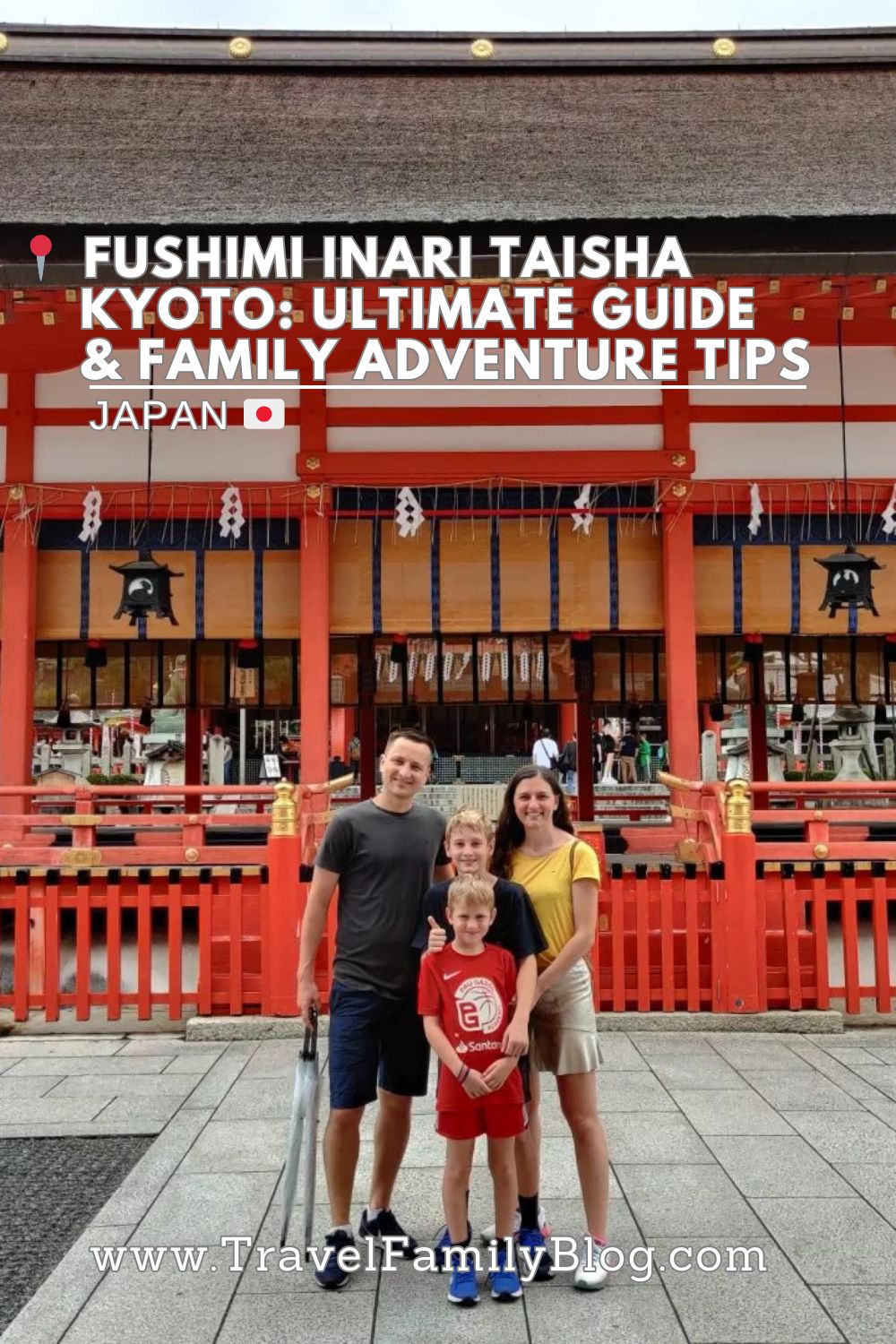
Day 3 in Kyoto, and one of the trip’s genuine highlights. The trail starts wide and ceremonial at the main gate and the Honden, then narrows into the gate tunnels, then turns into forest and steps.
What surprised us was how quickly the atmosphere changed with altitude. Down at the bottom it’s a landmark with a crowd; twenty minutes up it’s rows of gates, birds, the occasional shrine bell, and not much else. The climb has a rhythm to it — gate after gate after gate — that gets close to meditative once you stop trying to photograph it.
Our two also found Totoro merchandise in the shops on the approach, which is apparently a theme of our Kyoto trip and which they rated roughly equal to the shrine itself.
What to bring
- Proper shoes. It’s stone steps for most of the ascent, and they’re uneven.
- Water, and more than you think. There are vending machines partway up, but not everywhere.
- Cash. Some of the small shops and shrine stalls don’t take cards.
- A small towel. Very Japanese, very sensible — it’s a sweaty climb in anything but winter.
- Layers. It’s cool at dawn and warm by mid-morning.

Things worth knowing
The foxes. Kitsune statues are everywhere, often holding a key, a scroll or a sheaf of rice. They’re not decoration — foxes are the messengers of Inari, the Shinto deity of rice, prosperity and agriculture, and the shrine has been the head of that network since 711 AD.
The gates are donations. Each torii was paid for by a person or a business, and the names and dates are painted on the back. Walking down instead of up, you can read them — which is a good way to keep older children interested on the descent.
Wild boar. There are warning signs about boar in the forested upper sections, mainly at dusk and after dark. They’re shy and sightings are rare, but it’s a real reason to stay on the marked paths if you’re up there late.
Is Fushimi Inari worth it with kids?
Yes, and it’s one of the few Kyoto sights where the answer isn’t complicated. It’s free, it’s five minutes from Kyoto Station, it’s open whenever you can face getting up, and it’s a walk rather than a museum — which with children is worth a great deal.
The only way to get it wrong is to arrive at eleven and set out to reach the summit. Go early, stop at Yotsutsuji, and come down.

The rest of our Kyoto
Sakura Cross Hotel Kyoto Kiyomizu review
Kinkaku-ji, the Golden Pavilion


What to See & Where to Stop?
Hidden bamboo paths / forest gems if you explore small side paths.
Main Gate & Honden: the starting point—photogenic and ceremonial.
Senbon Torii: the famous thousands-gate tunnel section.
Yotsutsuji Intersection / Viewpoint: about halfway up, great panorama.
Sub-shrines / Hokora dotted along the trail—quiet, spiritual, beautiful.
Still deciding where to base yourself? See where to stay in Kyoto with kids.
Frequently asked questions about Fushimi Inari
Is there an entrance fee for Fushimi Inari?
No. Fushimi Inari Taisha is free to enter and open 24 hours a day, all year round. There is no ticket and no gate, which is part of why it works so well as an early-morning or after-dark visit.
How far up Fushimi Inari should you go with kids?
The Yotsutsuji viewpoint, about halfway up, is the sweet spot — around 1.5 to 2 hours there and back, with a panorama over Kyoto and a natural place to turn round. The famous dense torii tunnels are much lower and can be reached in about fifteen minutes, which is enough with toddlers. The full summit loop is 2 to 3 hours and suits older children who want a hike.
How long does the full Fushimi Inari hike take?
The complete loop of Mount Inari is around 4 km with about 233 metres of ascent and takes two to three hours depending on pace and stops. Most of the climb is on stone steps.
What is the best time to visit Fushimi Inari?
Before about 7 or 8 in the morning, or after sunset. Early morning gives you near-empty gates and the best light; after dark the shrine is lit and much quieter. Midday means queuing to walk through the torii tunnels.
How do you get to Fushimi Inari from Kyoto Station?
Take the JR Nara Line to Inari Station, which takes about five minutes, then walk roughly five minutes to the shrine entrance. The Keihan Line to Fushimi-Inari Station is an alternative. The JR route is covered by the Japan Rail Pass.
Are there wild animals on the Fushimi Inari trail?
There are warning signs about wild boar in the forested upper sections, particularly around dusk and after dark. Sightings are rare and the animals are shy, but it is a good reason to stay on the marked paths if you are walking the upper trail at night.

12 Comments