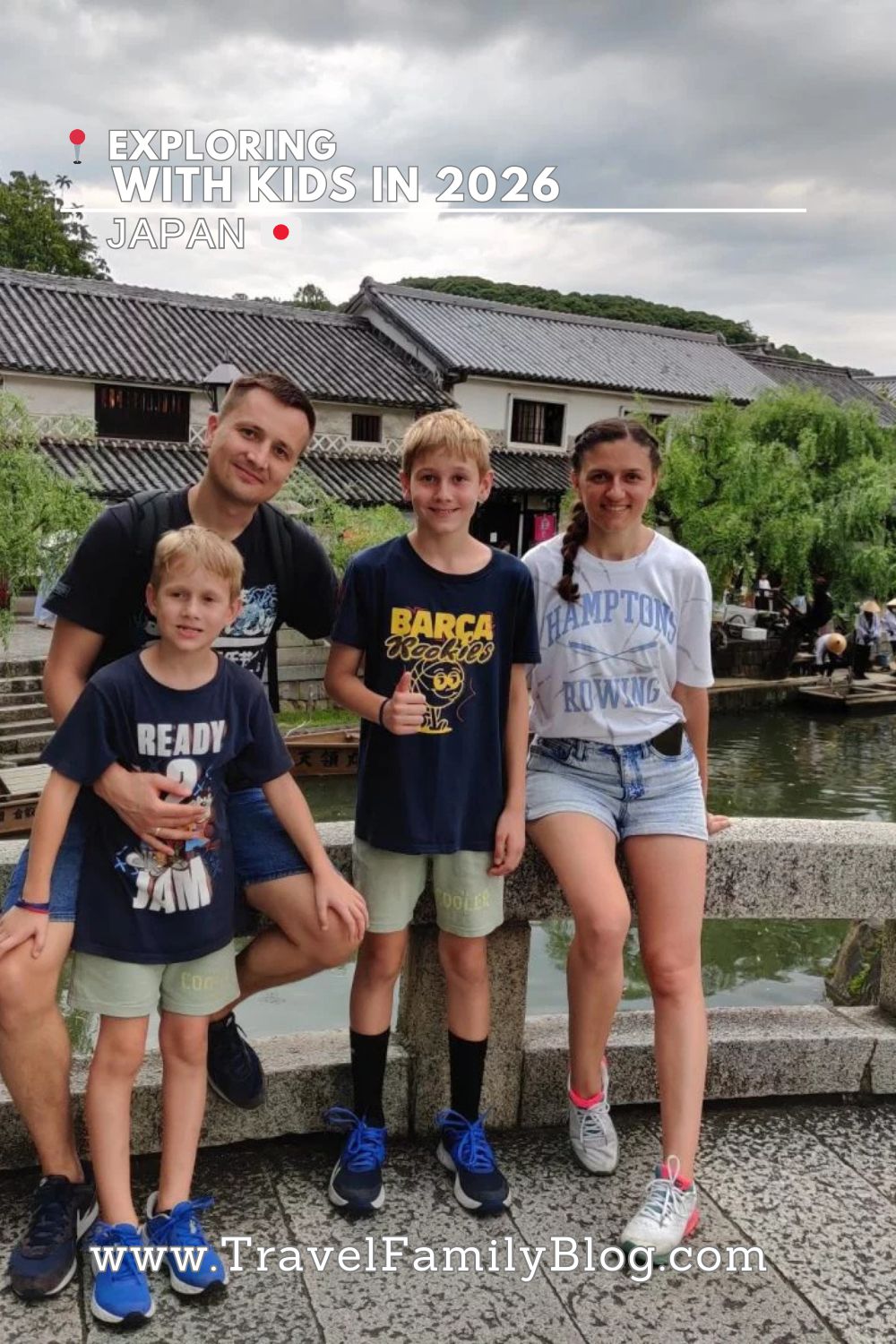
Most people see Kurashiki in photographs — white storehouses, willow trees, a canal — and file it under “pretty, probably not worth the detour with children.”
We went in July 2023 with a ten-year-old and a seven-year-old, near the end of nineteen days in Japan, and it turned out to be one of the most useful half-days of the trip. Not because it was the most beautiful thing we saw. Because by that point in the itinerary, what the four of us needed was somewhere small, flat, shaded and short.
Where to stay in Osaka with kids
Hotel Hankyu Respire Osaka – Umeda, above the shops beside JR Osaka Station, with triple and quad rooms. Every line in the city starts downstairs, which is what makes day trips painless.
Mimaru Osaka Namba North – separate bedroom and living area, a short walk from Dotonbori but far enough back from the canal to sleep. Some units are Pokémon-themed.
The Park Front Hotel at Universal Studios Japan – under a minute from the USJ gates, triple and quad rooms. Worth one night before your park day, not a whole stay — the bay is far from everything else.
In Osaka we stayed with family, so none of these are our own stays — they’re the ones we’d book, chosen on room capacity and location. Affiliate links — we may earn a small commission at no extra cost to you.
The short version
- Half a day is right. Three to four hours covers everything worth doing with kids.
- It is free with a JR Pass — Shinkansen to Okayama, then fifteen minutes on the JR Sanyo line.
- The Bikan quarter is a 10–15 minute walk from Kurashiki Station, and it is flat.
- The canal boat is ¥500 for about 20 minutes and is the single best thing here for children.
- Ohara Museum of Art is ¥2,000 for adults and ¥500 for school-age children — the most expensive thing in town and not the one I would pick with young kids.
- Momotaro Karakuri Museum is ¥600 adults / ¥400 school-age / ¥100 from age 5 and is the one they will actually talk about afterwards.

Why stop in Kurashiki at all?
Because of where it sits.
Kurashiki is twenty minutes from Okayama, and Okayama is on the main Shinkansen line between Osaka and Hiroshima. If you are travelling west at any point — and most two-week Japan itineraries do — you pass within a few minutes of it. With a rail pass the detour costs nothing but time.
And what you get for that time is the thing a family itinerary runs short of by week two: somewhere that asks nothing of you. No queue, no timed entry, no climb, no crowd, and a historic quarter small enough that a seven-year-old can walk all of it without being carried.
Getting to Kurashiki
From Osaka or Kyoto: Shinkansen to Okayama, then the JR Sanyo main line to Kurashiki — about fifteen minutes. Both legs are covered by the Japan Rail Pass.
From Hiroshima: the same in reverse.
From Kurashiki Station to the Bikan quarter: about a 10–15 minute walk, flat and straightforward.
Related: is the JR Pass worth it?
What Kurashiki is: a short history that children will sit through
Kurashiki means “town of storehouses”. During the Edo period (1603–1867) it was a rice distribution centre, and the white-walled kura along the canal were the warehouses. The canal existed to move rice, not to look beautiful.
That is worth telling children in exactly those terms, because “this was a place for storing rice and the canal was the road” is a story a seven-year-old can hold, and it makes the buildings mean something rather than just being old.
The historic quarter — Kurashiki Bikan Historical Quarter — was preserved from the mid-20th century and is a designated Important Preservation District. The storehouses are now museums, cafés and craft shops.
The canal boat: do this one
¥500, about 20 minutes. Flat-bottomed wooden boats, poled along a 150-metre stretch of canal under the willows and the stone bridges.
It is short, it is cheap, and it is the correct amount of boat for a child. Twenty minutes is long enough to feel like a proper ride and short enough that nobody gets restless. Sitting low on the water changes the whole scale of the quarter — the storehouses look larger, the bridges look older.
Running times: daily 9:30–17:00 from 1 March to 30 November; weekends only from December to February. So in winter, check the day before you build a plan around it.


Momotaro Karakuri Museum: the one they will remember
¥600 adults, ¥400 school-age children, ¥100 from age 5. Open 10:00–17:00, every day. About an hour.
This is a small, slightly ramshackle museum built around Momotaro, the Peach Boy — the folk tale of a child who comes out of a giant peach and goes off to fight ogres. It is one of the best-known stories in Japan and most visiting children have never heard it, which makes it a better introduction to Japanese folklore than any temple.
What is actually inside: around fifteen hands-on optical illusions — including one where you put your head out of a split peach and appear to lose your body — and a 25-metre walk-through ogre cave with air jets and lurching figures. It is a haunted-house corridor scaled for children: startling, not frightening.
Cash, cards and PayPay all accepted, which is not a given in a town this size.


Ohara Museum of Art: excellent, and think twice with young children
¥2,000 for adults, ¥500 for elementary, junior high and high school students. Open 9:00–17:00 March to November (last entry 16:30) and 9:00–15:00 December to February. Closed Mondays.
It is Japan’s first private museum of Western art, and the collection is genuinely serious — Monet, Picasso, Matisse, El Greco. The building and gardens are lovely.
It is also ¥2,000 a head, closed on Mondays, and a quiet gallery of European paintings, which is a lot to ask of a seven-year-old at the end of a long trip. With older children who like art, do it. With younger ones, spend the money on the boat and the ogre cave and walk the gardens instead. I would rather tell you that than pretend every attraction suits every family.
Kurashiki Ivy Square
A Meiji-era cotton mill converted into red-brick courtyards, shops and cafés, covered in ivy. Free to walk through.
Its real function in a Kurashiki morning is contrast — after an hour of white Edo walls, the red brick resets everyone’s eyes. It is also shaded, which in July is not a small thing.
Achi Shrine and the view
A short climb above the Bikan quarter to a quiet shrine with a view back over the rooftops and the canal. Free.
Ten minutes up. Worth it if everyone still has legs; entirely skippable if they don’t.
Kurashiki in July, which is when we went
Most guides tell you to avoid Japanese summer. Having done Kyoto, Osaka and Nara in the same fortnight, I would put Kurashiki among the easier July stops in Japan, and here is why:
- It is flat. No steps, no climb, no hill — unlike almost everything in Kyoto.
- The willows are continuous shade along the whole canal walk.
- It is small. You are never more than a few minutes from a café or a museum with air conditioning.
- The canal moves air. It is measurably more pleasant beside the water than in the streets behind.
What it is not is cool. Okayama prefecture in July runs hot and humid like everywhere else. The difference is that Kurashiki does not also ask you to climb anything.
More on this: Japan in July with kids


The evening lighting
After the day visitors leave, the Bikan quarter is lit — reportedly to a design by the lighting designer Motoko Ishii — and the reflections in the canal are the version of Kurashiki that ends up in photographs.
The honest caveat: most shops and museums close around 16:30–17:00, so an evening visit is beautiful and empty and there is nothing open. If you have children who are already tired, the lighting is a reason to stay the night, not a reason to stay two extra hours.
A half-day plan that works
| Time | What |
|---|---|
| 09:30 | Arrive, walk from the station into the Bikan quarter |
| 10:00 | Canal boat — do it before the queue and before the heat |
| 10:30 | Momotaro Karakuri Museum, about an hour |
| 11:45 | Walk the canal, craft shops, Ivy Square |
| 12:30 | Lunch |
| 13:30 | Ohara Museum (older kids) or Achi Shrine and the gardens (younger) |
| 15:00 | Train onward |
Is Kurashiki worth it with kids?
Yes — as a half-day, not a destination.
Go if you are passing through Okayama, if you have a rail pass, and if you are far enough into a Japan trip that the children have started sighing at the word “temple”. Kurashiki is the antidote to that specific problem and it is very good at it.
Do not build a Japan itinerary around it, and do not give it a whole day. Three or four hours is exactly right, and leaving while everyone still likes it is the point.
If you are planning the wider trip: our full Japan itinerary with kids · a day trip to Uji from Kyoto
| Time | Activity |
|---|---|
| Morning | Arrive at Kurashiki, walk through Bikan Historical Quarter, visit local craft shops, rent kimono/yukata if desired. |
| Midday | Lunch at a kid-friendly café; visit the Ohara Museum of Art + grounds. |
| Afternoon | Momotaro Museum or Local History Museum; take a canal boat ride; visit Ivy Square. |
| Evening | Dinner; stroll during/after lighting; relax at riverside or under willow trees. Optional sunset view from Achi Shrine. |
FAQ
How long do you need in Kurashiki with kids?
Half a day. Three to four hours covers the canal boat, one museum, the Bikan quarter walk and lunch, which is everything worth doing with children. A full day means stretching it, and leaving while everyone is still enjoying it is the point.
How do you get to Kurashiki from Osaka or Kyoto?
Take the Shinkansen to Okayama, then the JR Sanyo main line to Kurashiki, which takes about fifteen minutes. Both legs are covered by the Japan Rail Pass. From Kurashiki Station the Bikan Historical Quarter is a flat 10 to 15 minute walk.
How much is the Kurashiki canal boat?
¥500 for a ride of about 20 minutes along a 150-metre stretch of the canal. It runs daily from 9:30 to 17:00 between 1 March and 30 November, and at weekends only from December to February. It is the single best thing in Kurashiki for children.
How much does the Ohara Museum of Art cost?
¥2,000 for adults and ¥500 for elementary, junior high and high school students. It opens 9:00 to 17:00 from March to November and 9:00 to 15:00 from December to February, and it is closed on Mondays. The collection is excellent but it suits older children far better than young ones.
What is there for young children to do in Kurashiki?
The Momotaro Karakuri Museum, which costs ¥600 for adults, ¥400 for school-age children and ¥100 from age 5. It has around fifteen hands-on optical illusions and a 25-metre walk-through ogre cave based on the Peach Boy folk tale. Together with the canal boat it is the part children remember.
Is Kurashiki good to visit in summer?
Better than most Japanese destinations. Kurashiki is flat, the canal walk is shaded by willows the whole way, and the quarter is small enough that air conditioning is never far. It is still hot and humid in July, but unlike Kyoto it does not also ask you to climb anything.