
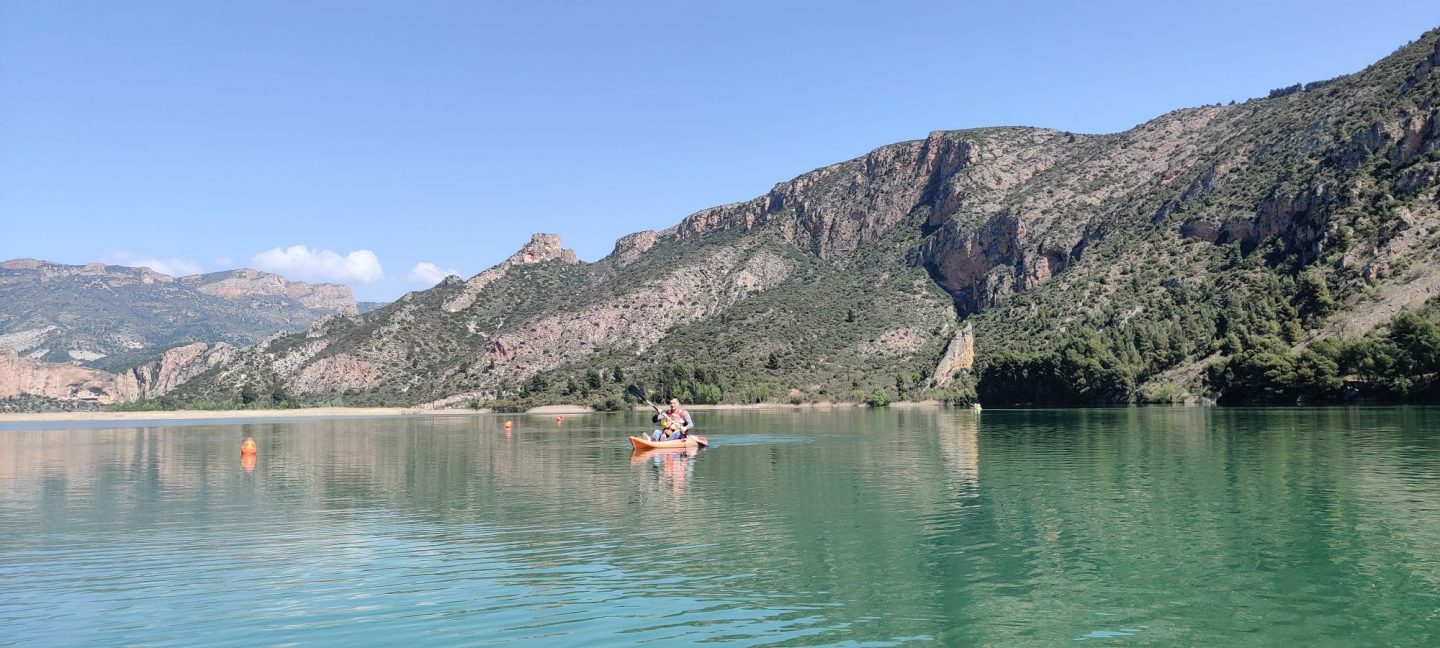
Two hours inland from Barcelona there’s a reservoir on the Segre where you can rent a kayak, paddle out into a wild fauna reserve, and be the only people on the water on a weekday.
It’s called the Pantà de Sant Llorenç de Montgai in Catalan and the Pantano de San Lorenzo in Spanish, it sits below Camarasa near Balaguer, and it is nothing like the coast. Flat green water between limestone walls, herons, and no waves.
We rented two kayaks for a couple of hours and went out with the boys. Here’s how it works — and one legal thing that almost nothing written about this place mentions.
Where it is, and how long it takes
Sant Llorenç de Montgai is in the province of Lleida, in the Noguera county, on the Segre — the river that comes down from the Pyrenees and joins the Ebro. Balaguer is the nearest town of any size, and Camarasa is the municipality the reserve sits in.
What the reserve actually is
The water sits inside the Reserva Natural de Fauna Salvatge de Sant Llorenç — a wild fauna reserve declared by the Generalitat de Catalunya in 1990, covering roughly 468 hectares, protected chiefly for migratory waterbirds.
What that means on the water: you’re paddling through a protected wetland, not a leisure lake. The birds are the reason it’s protected, so if you’re quiet you’ll see a lot more than you expect. Take binoculars if you have them.
Renting the kayaks
We rented from Camping La Noguera, which sits on the reservoir and rents kayaks, paddle surf boards and mountain bikes.
The bit that made it easy: you take the kayak out and pay when you bring it back, based on how long you had it. No fixed slot to book, no rush to get back for a deadline. With children that’s worth a lot — you can go out for two hours and come in after one if it isn’t working.


One thing to sort out before you paddle
The Segre drains into the Ebro — so navigation here is regulated by the Confederación Hidrográfica del Ebro, not by the Catalan water agency. And the CHE requires a declaración responsable de navegación for paddling craft.
Kayaks need one. Paddle surf boards don’t. The CHE specifically exempts “tablas de windsurf, kitesurf, paddle surf, los patos o tubo float sin motor, las barcas y bicis acuáticas a pedales” as bathing accessories — and kayaks are not on that list.
Declarations run for one to five years for an individual. And on reservoirs classified A or R there’s a mandatory zebra-mussel disinfection at an official station on first entry, and you keep the ticket as proof.
What this means in practice: renting is the easy option, because a commercial operator normally covers its clients under its own declaration. Bringing your own kayak means doing the paperwork first.
What else is on the same water
This is why it works as a whole day rather than an hour’s paddle. Camarasa’s own tourist information lists hiking, kayaking, fishing, climbing and mountain biking, all year round.
The climbing is genuinely good
According to the Diputació de Lleida’s tourism board, the routes here run from grade V to 9a, on walls 15 to 100 metres high. Most sectors are shaded until 2pm, and the season is described as autumn, winter and spring — plus summer mornings.
Access is described as “fàcil” from the road for most sectors, with Solàrium about a 45-minute walk in.
And one detail worth knowing: the Fashion and Selva sectors are reached by crossing a via ferrata. So there is a via ferrata here — officially it’s described as the access route to two climbing sectors rather than a standalone attraction, which is a distinction worth making before anyone drives out expecting a family via ferrata day.
The birds
The whole reason the place is protected. 468 hectares of reserve, designated for migratory waterbirds — so this is a serious birdwatching spot rather than an incidental one, and Camarasa lists ornithological routes among its official activities.
Doing it with children
The water is the main argument. A reservoir has no waves, no swell and no tide, so a child in a kayak here is dealing with none of the things that make the sea difficult. It’s the reason we brought the boys out on flat water first.
For younger children, a tandem kayak with an adult is the way to do it — child in front, adult steering from the back.
Bring: sunscreen, water, hats, and something dry to change into. There’s no shade on open water.


Is it worth the drive?
Yes, if you understand what you’re driving to.
It’s about two hours each way for a quiet reservoir in a bird reserve, with climbing on the walls above it. That’s a good day out and a genuinely different landscape from the coast — inland Catalonia, limestone and water, nobody there.
Go if you want flat-water paddling to build children up on, or you’re combining it with the climbing.
Don’t go expecting a beach day. There’s no sand, no lifeguard and no facilities beyond the campsite.
Other water and adventure days we’ve done
How we built the boys up to a full day in a kayak · Sailing a J24 from Port Olímpic · Every adventure activity we’ve tried near Barcelona · Day trips from Barcelona
Reserve status verified at camarasa.cat and climbing information at aralleida.cat, September 2026. Navigation rules from the Confederación Hidrográfica del Ebro. Rental prices were not verifiable — contact the campsite.
Frequently asked questions
Where is the Pantano de San Lorenzo?
On the Segre in the province of Lleida, below Camarasa and near Balaguer, in the Noguera county. Its Catalan name is the Pantà de Sant Llorenç de Montgai. It is roughly two hours inland from Barcelona by car.
Do you need a permit to kayak at Sant Llorenç de Montgai?
If you bring your own kayak, yes. The Segre drains into the Ebro, so navigation is regulated by the Confederación Hidrográfica del Ebro, which requires a declaración responsable de navegación for paddling craft — kayaks included. Paddle surf boards are exempt as bathing accessories. On reservoirs classified A or R there is also a mandatory zebra-mussel disinfection on first entry, with the ticket kept as proof. Renting from a commercial operator is simpler, because operators normally cover their clients under their own declaration — worth confirming when you book.
Is Sant Llorenç de Montgai a nature reserve?
Yes. The Reserva Natural de Fauna Salvatge de Sant Llorenç was declared by the Generalitat de Catalunya in 1990 and covers roughly 468 hectares, protected chiefly for migratory waterbirds. That is why the water is quiet and why a kayak makes such a good bird hide here.
Can you climb at Sant Llorenç de Montgai?
Yes, and it is a serious climbing area rather than an afterthought. The Diputació de Lleida publishes routes from grade V to 9a on walls 15 to 100 metres high, with most sectors shaded until 2pm and a season covering autumn, winter, spring and summer mornings. Access is easy from the road for most sectors, though Solàrium is about a 45-minute walk. Note that reaching the Fashion and Selva sectors means crossing a via ferrata.
Is there a via ferrata at Sant Llorenç de Montgai?
There is one, but it is officially described as the access route to the Fashion and Selva climbing sectors rather than as a standalone attraction. So it is not the kind of set-piece family via ferrata you would drive out for on its own.
Is kayaking at Sant Llorenç de Montgai good with kids?
The flat water is the argument: a reservoir has no waves, no swell and no tide, so it removes everything that makes the sea difficult for a child in a kayak. For younger children a tandem kayak with an adult works best, with the child in front and the adult steering from the back. Check the minimum age with whoever you rent from, and bring sunscreen, water and hats — there is no shade on open water.
What else can you do at Sant Llorenç de Montgai?
Camarasa’s own tourist information lists hiking, kayaking, fishing, climbing and mountain biking, all year round, plus ornithological routes through the reserve. That combination is what makes it a full day rather than an hour’s paddle.
