
There is a large rock on the beach at Blanes called Sa Palomera. It splits the town’s coastline in two, and by long local convention it marks the exact point where the Costa Brava begins.
South of that rock is the Maresme. North of it is the Costa Brava. They are two completely different kinds of coast, they suit completely different trips, and almost every English-language guide to Barcelona treats them as one place.
That confusion costs people their day out. Here’s the difference, why it matters, and which one you actually want.
The short answer
| Maresme | Costa Brava | |
|---|---|---|
| Where | Montgat to the Tordera river | Blanes to the French border |
| The beaches | Long, wide, open sand | Small coves between pine cliffs |
| Railway? | Yes — the R1 runs the whole length | No |
| Car needed? | No | Effectively yes |
| Who uses it | Barcelona families, on a Tuesday | People on holiday |
| Best for | A beach day | A week, or a day trip with something to see |
If you want a beach day from Barcelona and you don’t have a car, you want the Maresme. If you want coves, cliffs and a proper holiday, you want the Costa Brava. That’s genuinely most of it.
Where the boundary actually is — and how to prove it
This is where most articles go wrong, so let’s be precise.
The Maresme is a comarca — an administrative county — and it runs from Montgat in the south-west to the Tordera river in the north-east. Its last coastal town is Malgrat de Mar, just south of the river mouth.
Blanes is on the other side of the Tordera, in the comarca of La Selva, in Girona province. Blanes calls itself the Gateway to the Costa Brava, and the Costa Brava runs from Blanes to the French border.
So the dividing line is a river, and the ceremonial marker is a rock. Sa Palomera, the outcrop dividing Blanes beach, is symbolically the start of the Costa Brava — and since 1958 the town has launched its famous fireworks competition from it.
The trick nobody uses: the fare zones prove it
Here’s a way to settle any argument about this coast, and it’s the reason the distinction isn’t just vocabulary. Barcelona’s integrated transport zones map the boundary almost exactly, because the zones follow the railway and the railway follows the Maresme:
| Station | Fare zone | Coast |
|---|---|---|
| Montgat, Badalona | 1 | Maresme |
| El Masnou, Ocata, Premià de Mar, Vilassar de Mar | 2 | Maresme |
| Mataró, Caldes d’Estrac | 3 | Maresme |
| Arenys de Mar, Canet, Sant Pol, Calella, Pineda de Mar | 4 | Maresme |
| Santa Susanna, Malgrat de Mar, Blanes | 5 | Maresme, then Costa Brava at Blanes |
| Tossa de Mar, Platja d’Aro, Cadaqués | No station at all | Costa Brava |
That last row is the whole point. The Costa Brava is the coast where the train stops existing. Blanes is the end of the line in every sense — the last station, the last fare zone, and the rock where one coast becomes the other.
The Maresme: the coast Barcelona actually uses
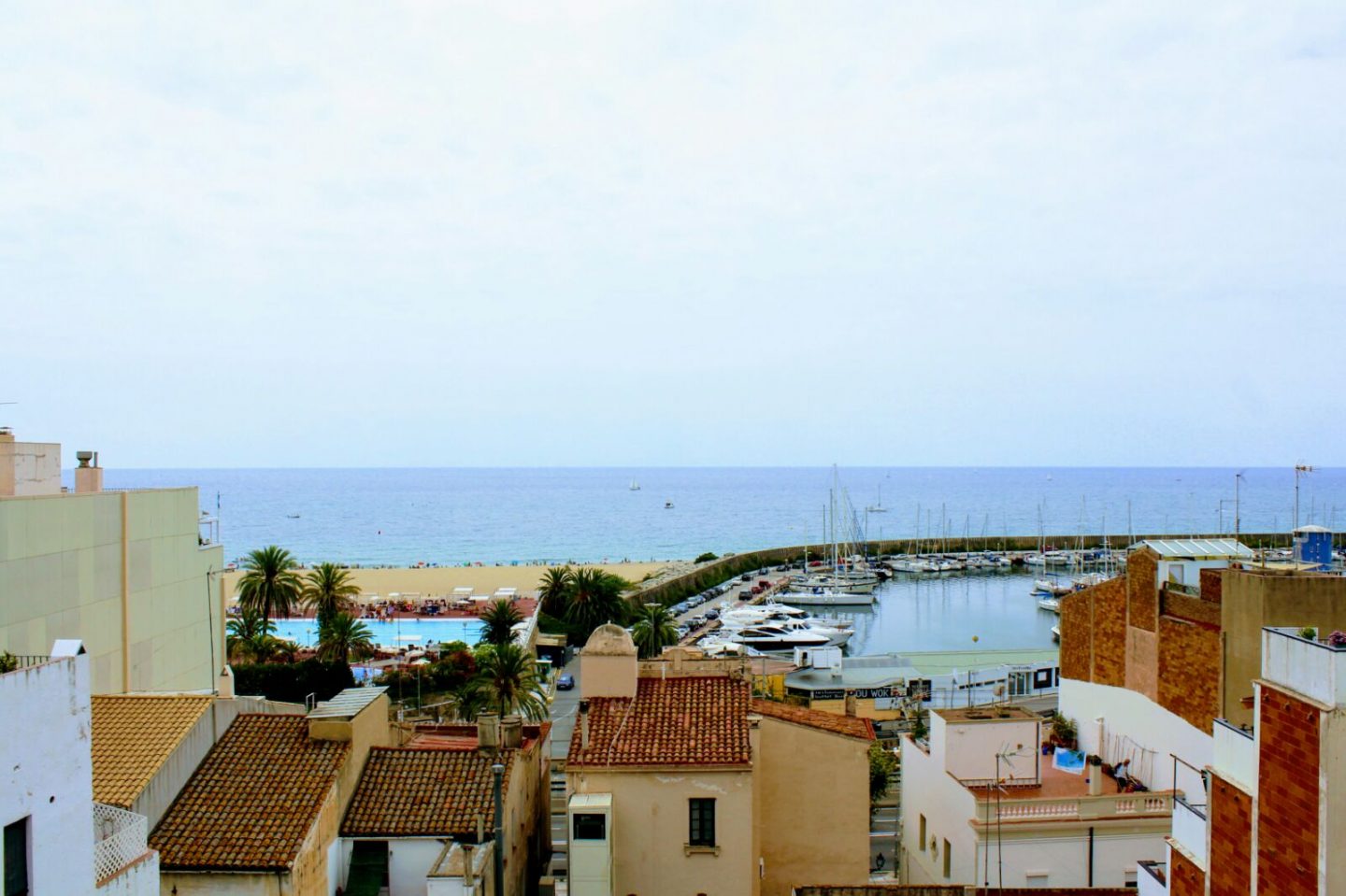
The Maresme is not a holiday coast. It’s where people from Barcelona go swimming after work.
The beaches are long, wide and open — not pretty in the postcard sense, but you can put a towel down in August without negotiating for space, which the Costa Brava’s coves cannot offer you. Behind them runs a nearly continuous promenade, and behind that, the railway.
The R1, which is the reason to care
The R1 line runs the entire length of the Maresme, frequently within metres of the water. For long stretches there is nothing between the carriage window and the sea but a low wall. It is, quietly, one of the most scenic commuter lines in Europe, and people ride it to work on it every day without looking up.
Practically, it means this: you can reach a real beach from central Barcelona on a travel card, in under an hour, without a car. That is a genuinely unusual thing for a major European city and almost no guide leads with it.
The two Maresme towns we’d send you to:
- El Masnou — fare zone 2, the closest decent beach. Twenty-something minutes. This is the after-work one
- Pineda de Mar — fare zone 4, about an hour, near the northern end of the coast. Free parking in front of the sand if you do drive, a beach bar that cooks proper fideuà, and catamaran hire at about €15 a head. The best full beach day on this coast without a car

What the Maresme doesn’t have
Anything to look at. No old quarters, no castles, no monuments worth the journey. These are towns people live in, with beaches attached. If you need your beach day to also be a sightseeing day, this is the wrong coast and you’ll be disappointed.
The Maresme is the cheaper coast — all three are on the Barcelona commuter line. These are affiliate links — we earn a small commission at no extra cost to you.
The Costa Brava: coves, cliffs, and no train
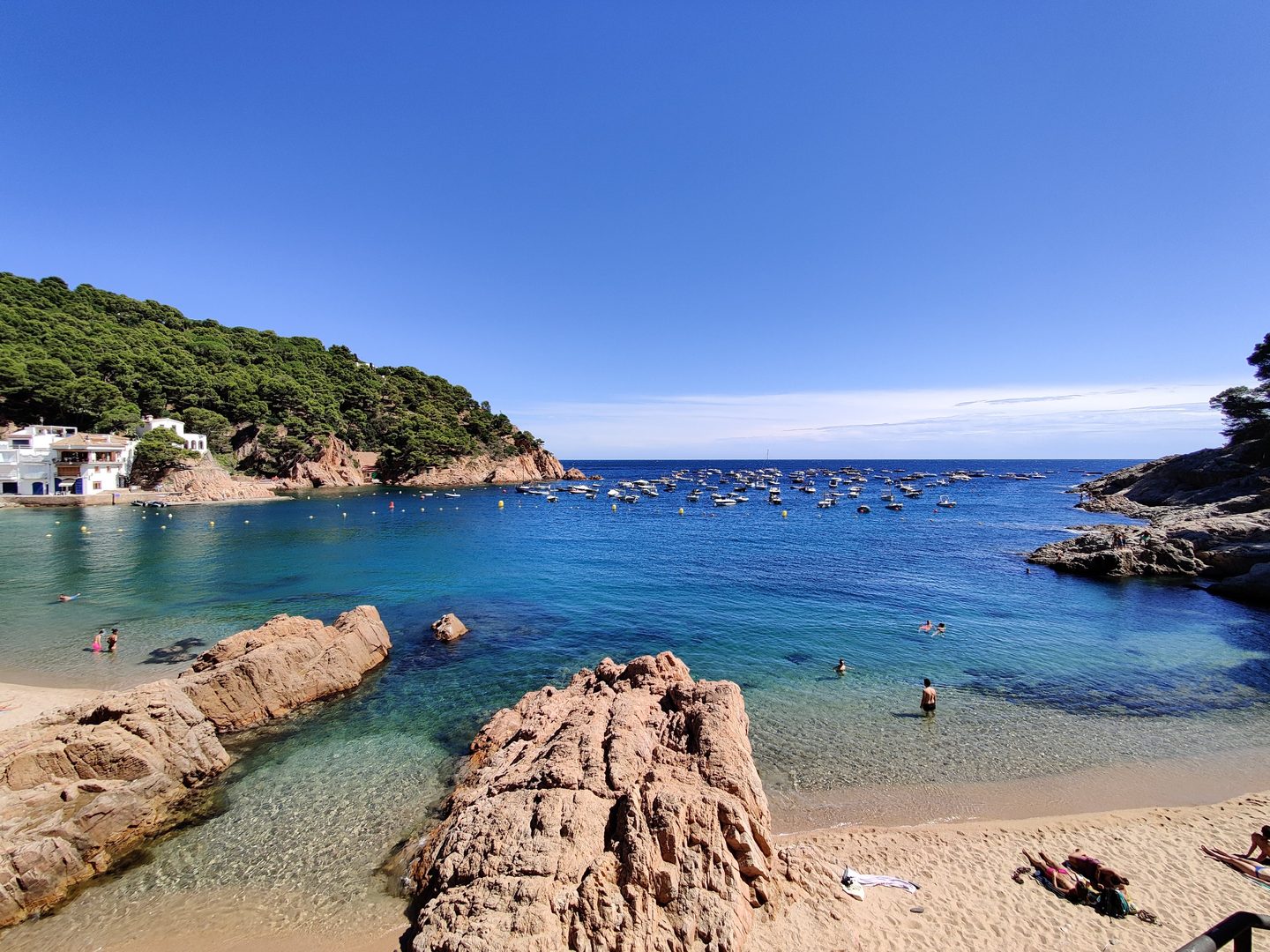
Costa Brava means “rugged coast,” and it was named that on purpose. North of Blanes the land stops being flat: the Catalan Coastal Range comes down to meet the sea, and the shoreline breaks into a long series of small coves — cales — separated by headlands of red rock and umbrella pine.
The water is clearer than on the Maresme, because there’s less river silt and more rock. Snorkelling is genuinely worth doing. And the coves are small, which means two things: they’re beautiful, and by eleven in the morning in August they’re full.
The catch, and it’s a big one
There is no railway. The line ends at Blanes. Every town worth visiting on the Costa Brava — Tossa de Mar, Platja d’Aro, Calella de Palafrugell, Cadaqués — is reachable only by car or long-distance coach.
That single fact changes the nature of the trip. The Maresme is a day out; the Costa Brava is a holiday, or at minimum a day with a hire car and a plan.
The two Costa Brava towns we’d send you to:
- Tossa de Mar — the one to pick for a day trip, because it has the only surviving fortified medieval town on the whole Catalan coast sitting directly above its main beach. Free parking, and something to walk around when you’ve had enough of the sand
- Platja d’Aro — the one to pick for a week with children. One big central beach plus five quiet coves, free parking in the centre, playgrounds, and enough restaurants that you won’t run out

And a third thing that isn’t a coast at all
Worth clearing up because it catches everybody: a lot of what gets sold as “Costa Brava” is nowhere near the sea.
Besalú, the medieval town with the fortified bridge, is routinely described as a Costa Brava day trip. It is 40 km inland, in La Garrotxa. Girona gets the same treatment and is also inland.
They’re both excellent. They’re just not the coast, and if you book a beach holiday expecting to walk to either, you’ll need the car again.
These are the three Lloret de Mar hotels we’ve actually stayed in. These are affiliate links — we earn a small commission if you book through them, at no extra cost to you.
So which one do you want?
Choose the Maresme if…
- You don’t have a car. This is the deciding factor and it outweighs everything else
- You want a beach day rather than a beach holiday
- You’re travelling with young children and want the journey to be short and simple
- You want space on the sand in August
- You’re staying in Barcelona and going out for the day
Choose the Costa Brava if…
- You have a car, or you’re willing to take a coach
- You want coves, clear water and snorkelling
- You’re staying a week rather than a day
- You want somewhere with an old town or a castle as well as a beach
- You’d rather drive twenty minutes to find an emptier cove than settle for the first beach you see
The honest verdict, after living here since 2010
The Costa Brava is more beautiful. The Maresme is more useful.
We’ve done both many times, and the pattern is simple: the Maresme is where we actually go — because it’s forty minutes on a train we can get to in ten, and a beach afternoon doesn’t need to be planned. The Costa Brava is where we go when we’ve decided to make a day or a week of it.
If you’re visiting Barcelona for a few days and want to see the sea properly, take the R1 up the Maresme one afternoon and don’t feel you’ve missed out. If you’ve got a week and a car, go north past Blanes and find a cove.
And if you’re choosing one town, sight unseen: Pineda de Mar without a car, Tossa de Mar with one.
Barcelona’s own beaches, if you’d rather not leave the city · all our day trips from Barcelona · how the travel cards and fare zones work
Frequently asked questions
What is the difference between the Maresme and the Costa Brava?
They are two different stretches of coast north of Barcelona. The Maresme runs from Montgat to the Tordera river and has long, wide, open sand beaches with a railway — the R1 — running along almost its entire length. The Costa Brava runs from Blanes to the French border and has small coves between pine-covered cliffs, with no railway at all. In practice: the Maresme is reachable without a car and the Costa Brava is not.
Where does the Costa Brava start?
At Blanes, in the comarca of La Selva. The traditional marker is Sa Palomera, a large rock that divides Blanes beach in two and is symbolically considered the beginning of the Costa Brava — the town has launched its annual fireworks competition from it since 1958. The administrative boundary is the Tordera river, just south of Blanes, which is also where the Maresme comarca ends.
Which coast near Barcelona can you reach by train?
The Maresme. The R1 line runs the whole length of it, often within metres of the water, so you can reach a real beach from central Barcelona on a travel card in under an hour. The Costa Brava has no railway — the line ends at Blanes, and Tossa de Mar, Platja d’Aro and Cadaqués all need a car or a long-distance coach.
Which is better, the Maresme or the Costa Brava?
The Costa Brava is more beautiful and the Maresme is more useful. Choose the Maresme for a beach day without a car, especially with young children, and for space on the sand in August. Choose the Costa Brava for coves, clear water, snorkelling, and a week rather than a day — but only if you have a car.
Is Pineda de Mar on the Costa Brava?
No. Pineda de Mar is on the Maresme, near the northern end of it, and the Costa Brava does not begin until Blanes. Its fare zone confirms it: Pineda is zone 4 on the Barcelona integrated network, while Blanes — the first Costa Brava town — is zone 5, and everything beyond Blanes has no station at all.
Is Besalú on the Costa Brava?
No, and this is a common confusion. Besalú is about 40 km inland, in La Garrotxa. Girona is inland too. Both are frequently sold as Costa Brava day trips, and both are worth visiting, but neither is on the coast.
Which beach town near Barcelona is best with kids?
Pineda de Mar if you do not have a car, because you can reach it on the R1 in about an hour, there is free parking in front of the sand if you do drive, the beach is wide enough that nobody is crowding you, and there is pushchair and wheelchair access onto it. Platja d’Aro if you have a car and a week, because it has one big beach plus five quieter coves, playgrounds and plenty of restaurants.
