
There is no bad month to come to Barcelona. There are months when something extraordinary is happening in the street outside your hotel for free, and months when there isn’t.
This is the calendar, month by month, after living here since 2010. What’s on, what it costs, which ones are genuinely worth planning a trip around, and — because nobody says this — which months are quiet.
One thing to understand before the list. Catalan festivals are not tourist events. They are a working calendar that the people who live here organise for themselves, and almost all of them are free. You’re not buying a ticket to a spectacle; you’re standing in a crowd of neighbours while something happens. That’s why they’re better than the paid attractions, and it’s also why nobody hands you a leaflet about them.
The year at a glance
| Month | What’s on | Worth planning around? |
|---|---|---|
| January | Three Kings (5–6 Jan) · ski season | Yes, if you have children |
| February | Santa Eulàlia · Carnival | Yes — and the quietest month for crowds |
| March | Not much | No. Come for the weather |
| April | Sant Jordi (23 Apr) · Easter | Yes. The best day of the year |
| May | Tarraco Viva · Corpus Christi (moves) | Yes, for Tarragona |
| June | Sant Joan (23 Jun) · Pyrenean fire festivals | Yes. The wildest night |
| July | Balloon Festival, Igualada | Yes, if you’ll travel out |
| August | Festa Major de Gràcia · Vilafranca castells | Yes, but it’s hot and the city half-closes |
| September | La Diada (11 Sep) · La Mercè (~24 Sep) | Yes. The best month overall |
| October | 48h Open House · Castanyada (31 Oct) | Yes, and the weather still holds |
| November | All Saints (1 Nov) | No. The quietest month |
| December | Christmas markets · Sant Esteve (26 Dec) | Yes, for the markets |
The short answer, if you only want one: September. La Mercè is the biggest festival of the year, the sea is still warm from summer, the August closures are over and the crowds have gone home. If September doesn’t work, late April for Sant Jordi.
January — Three Kings, and the mountains open
The Three Kings, 5–6 January, every year.
This is the big one for children in Spain, and it is bigger than Christmas Day here. On the evening of 5 January every town holds a cavalcada — the Three Kings arrive in procession and throw sweets into the crowd. In Barcelona they arrive by sea, landing at the port before processing through the city, which is a better piece of staging than anything a theme park has managed.
6 January is a public holiday and the day children get their presents. Almost everything is closed.
Bring a bag. The sweets are thrown hard and in quantity, and local children come equipped.
Read the full Three Kings guide →
Also in January: the ski season is running in the Pyrenees. La Molina is about two hours from Barcelona and doable as a day trip, which surprises people — you can be on snow in the morning and back in the city for dinner.
February — the month nobody comes, and the festival built for children
February is the emptiest tourist month in Barcelona. It is also, for families, one of the best, and almost nothing in English explains why.
Festes de Santa Eulàlia
Barcelona’s winter festival, held around 12 February, the feast day of Santa Eulàlia — one of the city’s two patron saints, and the one who gets the children’s festival.
The city’s own description of it is “Children play the leading role for Santa Eulàlia”, and it means it. Dance, fire, giants, and the programme built around younger participants taking centre stage across the city.
This is the only major Barcelona festival explicitly organised around children, and it falls in the quietest month of the year. No crowds, no queues, cheap flights, cheap hotels, and a festival designed for exactly your family. If you’re choosing a month for a first trip with small children and you don’t need beach weather, this is it.
Carnival
Carnestoltes moves, because it ends on Ash Wednesday and Easter moves. Barcelona does a decent version; Sitges does the famous one, forty minutes down the coast, and it is very large and not primarily aimed at children.
March — the honest month
Not much happens in March, and I’d rather tell you that than invent something.
What March has going for it is the thing the festival calendar can’t give you: good walking weather, low prices and no crowds. The city is pleasant, the parks come back to life, the terraces reopen and you can get into Sagrada Família without planning your day around it.
If you want a city rather than an event, March is quietly one of the best choices. It is also ideal day-trip weather — Girona and Tarragona are far better in March than in August.
April — Sant Jordi, the best day of the Catalan year
23 April, every year. Not a public holiday, which is the whole point.
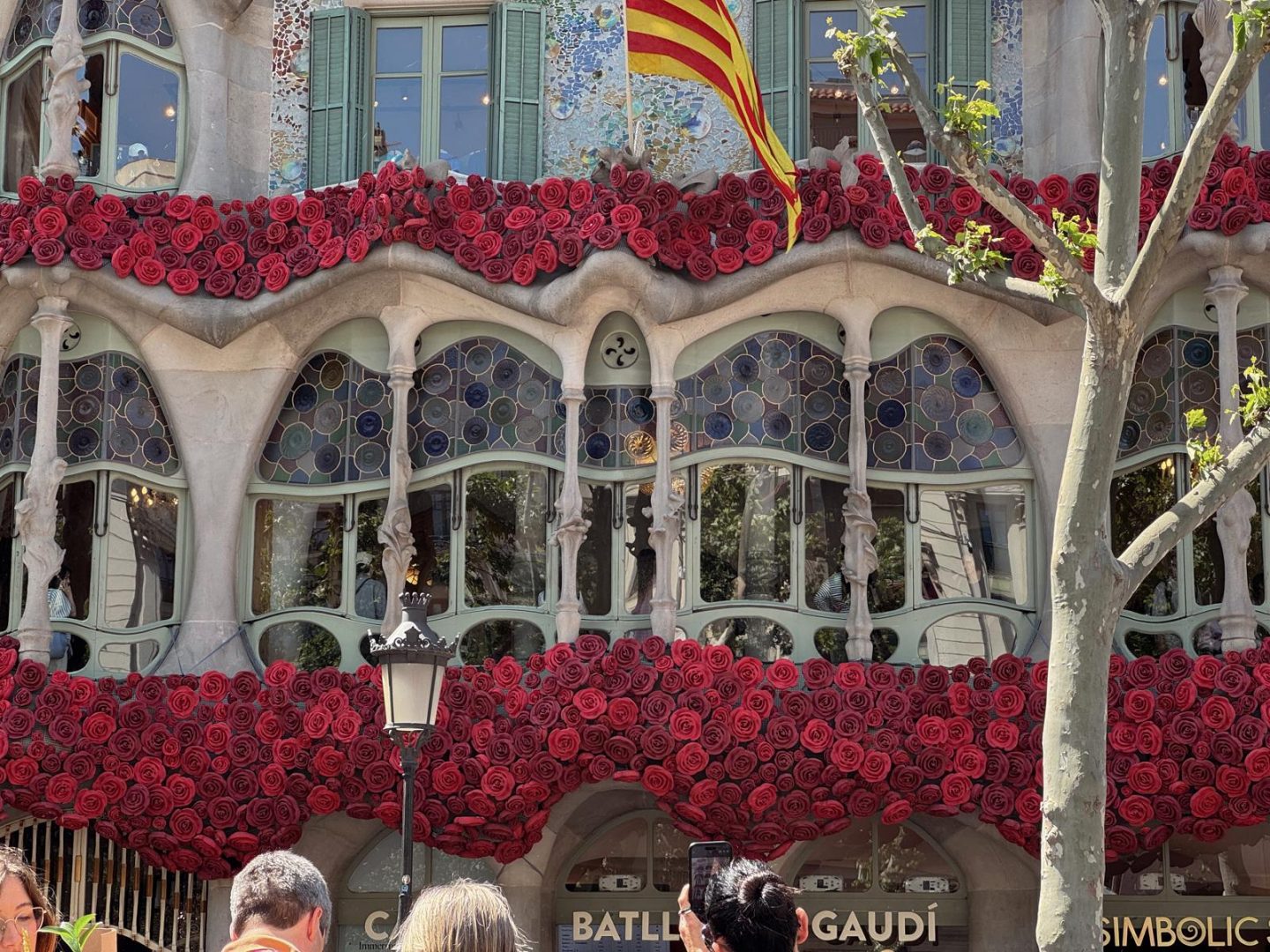
On Sant Jordi the city fills with book stalls and rose sellers, and the tradition is that you give a book and a rose to the people you love. Las Ramblas and Passeig de Gràcia become one long bookshop, authors sit at tables signing for hours, and several million roses are sold in a day.
And everybody goes to work. That’s what makes it extraordinary rather than a tourist event: it is a normal Thursday on which the entire population buys each other books. There is no parade, no ticket and no stage. The festival is the crowd.
If you can only be in Barcelona for one day in the year, make it this one.
Read the full Sant Jordi guide →
Also in April: Setmana Santa (Holy Week) moves with Easter and can fall in March or April. Good Friday and Easter Monday are public holidays here and the city gets busy with Spanish and French visitors.
May — Romans in Tarragona
Tarraco Viva, in Tarragona, usually in May: a Roman history festival with reenactments and military displays staged inside the actual Roman monuments.
Watching a legionary drill in a real Roman amphitheatre above the sea is a considerably better experience than reading the information panel next to it, and with children it’s the difference between a ruin and an afternoon. Tarragona is an hour by train.
Corpus Christi also often falls in May or June — it moves. Three things worth knowing about it:
- L’ou com balla — “the dancing egg.” An emptied eggshell is balanced on the jet of a cloister fountain and spins there. It is small, strange and very Barcelona
- Sitges carpets its streets with flowers for it
- La Patum de Berga — a medieval fire festival in the Pyrenean foothills, on UNESCO’s Representative List of the Intangible Cultural Heritage of Humanity since 2008. Dense, loud, packed with fire, and not a beginner’s festival
June — Sant Joan, and the same night in the mountains
The night of 23 June, every year. 24 June is a public holiday.
Sant Joan is the midsummer festival and it is the loudest night in Catalonia by a wide margin. Bonfires on the beaches, fireworks set off by absolutely everybody from about nine in the evening until sunrise, cava, and a sweet bread called coca de Sant Joan that appears in every bakery for a week beforehand.
Be realistic with children. The fireworks are not organised displays — they’re thousands of private ones, at street level, all night, and the bangs are constant. Small children will not sleep, and the beach after midnight is not a family environment. Go down for the bonfires at dusk and be indoors by eleven, or plan the night properly and accept nobody sleeps.
The version of Sant Joan nobody writes about in English
While Barcelona burns things on the beach, the Pyrenean villages do the same night completely differently — and theirs is the one UNESCO recognised.
The summer solstice fire festivals of the Pyrenees were inscribed on UNESCO’s Representative List of the Intangible Cultural Heritage of Humanity in 2015, shared between Spain, Andorra and France. Torches are lit at the top of the mountain at nightfall and carried down to the village in a moving line of fire.
Same night, same solstice, same fire — sea level and altitude. If you want midsummer without ten thousand people on a beach, go up instead of down.
July — hot air balloons over Igualada
The European Balloon Festival at Igualada, about an hour inland, is the biggest balloon meet in Spain.
The thing to know is when to be there: the balloons fly at dawn and at dusk because that’s when the air is calm, and the evening night glow — balloons tethered on the ground, burners firing in the dark — is the one to bring children to. Mid-afternoon there is nothing in the sky and a lot of heat.
2026 edition: 8–12 July. Dates move each year — confirm and update this line annually.
Read the full Balloon Festival guide →
Also in July: peak beach season. If you’re choosing a coast, this explains the difference.

August — Gràcia decorates itself, and the city half-shuts
Festa Major de Gràcia, mid-August
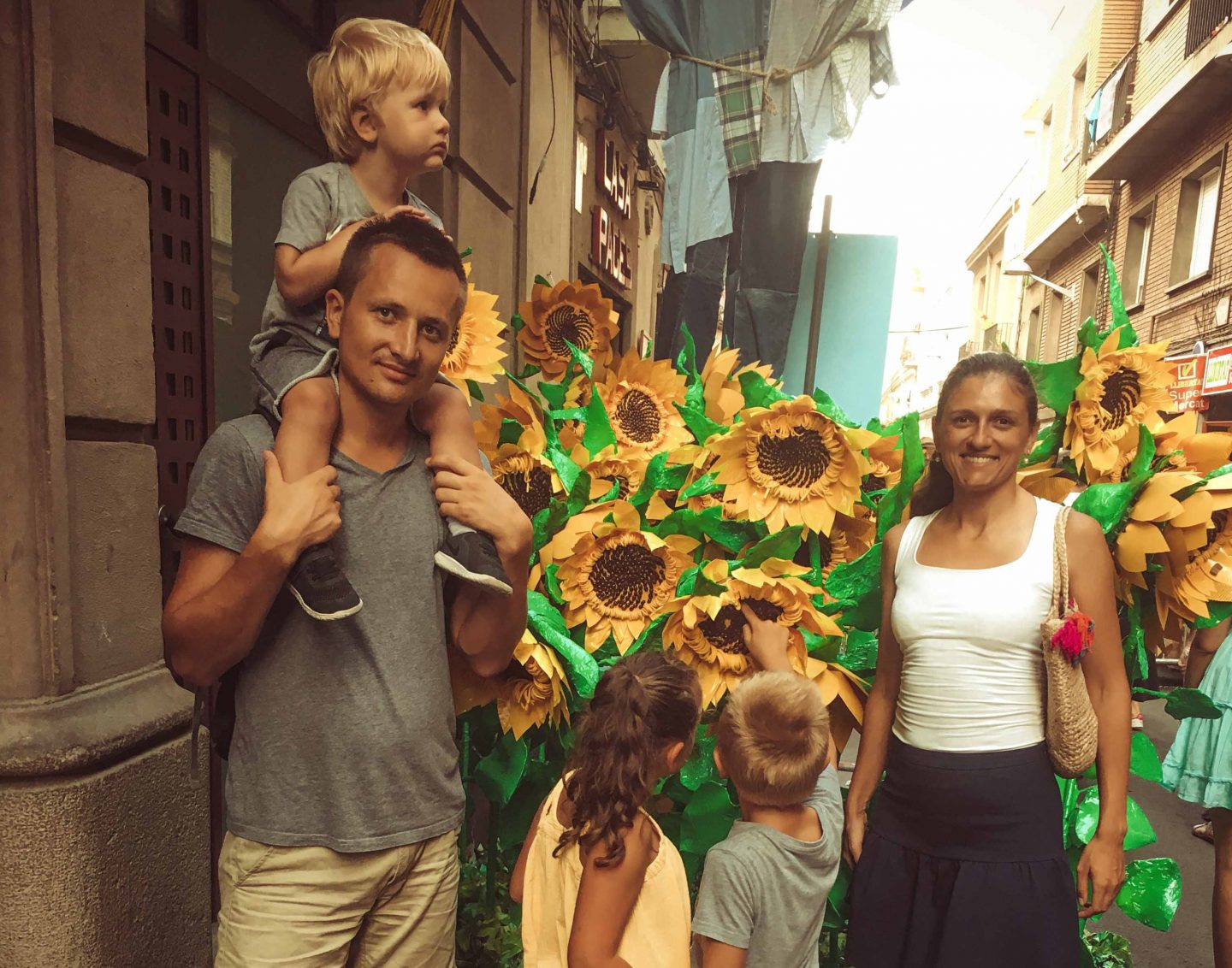
For about a week in mid-August, the streets of the Gràcia neighbourhood compete to decorate themselves, and they take it seriously: whole streets roofed over in handmade sculpture built by residents over months, out of recycled material, to a theme.
It’s free, it’s outdoors, it’s at its best after dark when everything is lit, and it is the most purely neighbourhood festival in the city — organised by the people who live on each street for the street next door to be jealous.
Go on a weekday evening rather than the weekend. The streets are narrow and the crowds at the weekend are genuinely difficult with a pushchair.
Read the full Festa Major de Gràcia guide →
Festa Major de Vilafranca del Penedès, around 30 August
If you want to see castells — human towers — at full height, this is one of the two places to do it. Vilafranca is forty minutes by train and its festival is one of the most serious casteller events of the year.
Human towers were inscribed by UNESCO in 2010, and UNESCO’s citation describes them as “an integral part of their cultural identity, transmitted from generation to generation and providing community members a sense of continuity, social cohesion and solidarity.”
Watching one go up is unlike anything else in Europe. There is no safety equipment. The child who climbs to the top goes last and comes down first.
The honest August warning
August is the worst month to visit Barcelona and the guides don’t say so. It is very hot and humid, the beaches are full, the prices peak — and a large number of the restaurants and small shops that locals use simply close for the month, because their owners have gone on holiday like everyone else. You get the tourist city with the real one switched off.
If August is your only option, it’s fine and you’ll have a good time. If you have a choice, September is the same weather without any of that.
September — the best month of the year
La Diada, 11 September
Catalonia’s national day, and a public holiday. It’s a political and civic day rather than a party, with large demonstrations in the city. Interesting to witness, worth understanding, and not something to bring children into the middle of.
La Mercè, around 24 September
Barcelona’s main festival, and the biggest thing that happens here all year. Several days built around the feast of the Mare de Déu de la Mercè, the city’s other patron saint, and nearly all of it is free.
What’s in it:
- Castellers — human towers in Plaça Sant Jaume
- Correfoc — the “fire run”: devils and dragons with fireworks moving through the crowd. This is genuinely dangerous if you’re unprepared — cotton clothing, covered arms and legs, a hat, and do not take small children into the run itself. Watch from a side street
- Gigantes — the giant processional figures
- Sardana dancing, concerts across the city, and free entry at many museums
- The Piromusical — the closing fireworks-and-music show at Montjuïc, and the best free thing in the Barcelona year
Between La Mercè, warm sea, and the city working normally again, September is the answer to “when should we come”.
Concurs de Castells, Tarragona — biennial, even years
The competition that decides the best casteller colla in Catalonia, held at the Tarraco Arena in Tarragona every two years, spanning late September and early October. 42 colles take part, and the final day brings the twelve best in the country.
The 2026 edition: 27 September in Torredembarra, then 3 October (18 colles) and 4 October (the 12 best) at the Tarraco Arena.
Because it’s biennial, the next one after 2026 is 2028. If you want to see castells at championship level rather than at a village festival, these are the dates, and there are only two chances a decade.
Confirm ticket prices at concursdecastells.cat.
October — Open House, and the chestnut festival
48h Open House Barcelona
One weekend a year, hundreds of buildings across Barcelona open their doors for free — private apartments, modernista interiors, institutional buildings, rooftops, places that are shut for the other 363 days.
The mechanic people get wrong: access is by timed groups with no registration. You do not book. You turn up and queue, and the festival publishes a live map showing queue lengths. So the strategy is to pick a district and work through it, not to plan a route across the city between appointments.
2026 edition: 24–25 October. Dates move — update annually.
There’s a children’s programme, Open Petits, running alongside it.
Read the full 48h Open House guide →
La Castanyada, 31 October
Catalonia’s own version of the end of October, and it predates the Halloween that’s now layered on top of it. Roasted chestnuts and sweet potatoes from street braziers, and panellets — small marzipan-and-pine-nut cakes that appear in every bakery for two weeks and are properly good.
1 November is a public holiday.
October is quietly one of the best months here — the sea is still swimmable, the heat has gone, the crowds have gone, and Open House is the single best free thing in the calendar after the Piromusical.
November — the quiet one
The emptiest month, and I’d say so. After 1 November there’s nothing in the calendar until the Christmas markets open at the end of the month.
Which makes it the cheapest time to come, and a reasonable choice if you want museums, food and no queues. The winter guide covers what the city is like off-season.
Late November: the Fira de Santa Llúcia opens at the cathedral and the lights go on.
December — markets, a log, and the thing in the nativity scene
Fira de Santa Llúcia
The Christmas market in front of the cathedral, running from around the start of December to the 23rd. It’s the oldest in the city and it’s where you buy the two Catalan Christmas objects that nobody warns visitors about.
Caga Tió and the caganer
Two traditions that are entirely real and that visitors never quite believe.
Caga Tió is a log with a face and a hat. Children feed it and cover it with a blanket through December, and on Christmas Eve they hit it with sticks while singing at it until it produces sweets.
The caganer is a figure of a person crouching with their trousers down, and it goes in the nativity scene. Traditionally tucked away at the back, as a fertility symbol — manure for next year’s crop. Modern ones are made in the likeness of politicians, footballers and celebrities, and picking which public figure to buy is part of the fun.
Both are on sale all over the Fira de Santa Llúcia. They are the best souvenirs in Catalonia and they make a much better story at home than a fridge magnet.
Read the full Christmas markets guide →
The dates
- 25 December — Nadal
- 26 December — Sant Esteve, a public holiday in Catalonia. Worth confirming against the current year’s official holiday list before publishing, but it’s a real Catalan distinctive: the region keeps 26 December when most of Spain doesn’t. The traditional dish is canelons made from Christmas Day’s leftovers
- 31 December — Cap d’Any, and twelve grapes at midnight, one per chime. Everybody does it and everybody struggles
And remember the presents come on 6 January, not 25 December. Christmas Day here is a family lunch; the Three Kings are the event. If you’re here over both, you get two.
So which month?
September if you want the best of everything — La Mercè, warm sea, no August closures, no crowds.
Late April for Sant Jordi, which is the most Catalan day of the year and the one I’d send anyone to.
February if you have small children and don’t need the beach — Santa Eulàlia is built around them and nobody else is here.
October for Open House and swimmable sea without the heat.
Avoid August if you have the choice, and don’t expect much from March or November beyond a quiet, cheap, pleasant city — which is sometimes exactly the right thing.
What to see in Barcelona · Twenty day trips · Barcelona in winter
Festival dates for fixed-date celebrations are the same every year. Moveable and annually scheduled events are marked — check the current year before travelling.
Frequently asked questions
What is the best month to visit Barcelona?
September. La Mercè, the city’s biggest festival, falls around the 24th and is almost entirely free; the sea is still warm from summer; the August closures are over and the crowds have gone. Late April is the other strong answer, for Sant Jordi on the 23rd. If you have small children and do not need beach weather, February is quietly excellent — the Santa Eulàlia festival is built around children and almost no tourists are there.
What is Sant Jordi?
Catalonia’s book and rose day, on 23 April every year. Book stalls and rose sellers fill the main streets and the tradition is to give a book and a rose to the people you love. What makes it remarkable is that it is not a public holiday — everybody goes to work, and the entire population buys each other books on a normal weekday. There is no parade, no stage and no ticket. The festival is the crowd.
When is La Mercè and is it free?
Around 24 September, running over several days, and yes — nearly all of it is free. It includes castellers in Plaça Sant Jaume, the correfoc fire run, giant processional figures, sardana dancing, concerts across the city, free museum entry on some days, and the Piromusical fireworks-and-music finale at Montjuïc, which is the best free event in the Barcelona year.
Is the correfoc safe with children?
Not in the run itself. The correfoc involves devils and dragons carrying lit fireworks moving through the crowd, and participants wear cotton clothing with covered arms and legs and a hat for a reason. Watch from a side street rather than joining, and do not take small children into the run. Many cities also hold a smaller children’s correfoc separately, which is the version to look for.
What are castells and where can you see them?
Human towers, built by amateur teams called colles standing on each other’s shoulders in successive levels, with a child climbing to the top last and coming down first. UNESCO inscribed them in 2010, describing them as an integral part of Catalan cultural identity, transmitted from generation to generation. You can see them at La Mercè in Barcelona in September and at the Festa Major de Vilafranca del Penedès around 30 August. The championship, the Concurs de Castells, is held at the Tarraco Arena in Tarragona every two years — 42 colles take part and the final day brings the twelve best in the country.
When is the Concurs de Castells in Tarragona?
It is biennial, held in even-numbered years across late September and early October. The 2026 edition runs on 27 September in Torredembarra and then 3 and 4 October at the Tarraco Arena in Tarragona, with the twelve best colles competing on the final day. Because it happens only every two years, the next edition after 2026 is 2028.
What happens at Sant Joan?
Bonfires on the beaches and private fireworks all night on 23 June, with 24 June a public holiday. It is the loudest night of the Catalan year and the fireworks are not organised displays but thousands of individual ones at street level until sunrise. With small children, go down for the bonfires at dusk and be indoors by eleven. In the Pyrenean villages the same solstice is marked by carrying lit torches down from the mountain to the village — those fire festivals were inscribed by UNESCO in 2015, shared with Andorra and France.
Do you need to book for 48h Open House Barcelona?
No, and that is the thing most people get wrong. Access to the buildings is by timed groups with no registration — you cannot book a slot. You turn up and queue, and the festival publishes a live map showing how long the queues are. The right strategy is to pick one district and work through it rather than planning a route across the city. The 2026 edition is 24–25 October, and there is a children’s programme, Open Petits, alongside it.
What is Caga Tió?
A log with a face and a hat. Catalan children feed it and keep it under a blanket through December, and on Christmas Eve they hit it with sticks while singing at it until it produces sweets. It is entirely real, it is sold all over the Fira de Santa Llúcia Christmas market, and along with the caganer — a figure crouching with its trousers down that goes at the back of the nativity scene — it makes a far better souvenir than a fridge magnet.
Why do Spanish children get presents on 6 January?
Because the Three Kings, not Father Christmas, bring them. The Kings arrive in procession on the evening of 5 January — in Barcelona they come in by sea and land at the port — throwing sweets into the crowd, and 6 January is a public holiday on which children get their presents. Christmas Day itself is a family lunch. If you are here across both dates, your children get two.
Which month should you avoid in Barcelona?
August, if you have a choice. It is hot and humid, the beaches and prices peak, and many of the restaurants and small shops locals use close for the month because the owners are on holiday — so you get the tourist city with the real one switched off. September has the same weather and none of that. March and November are not bad, just empty: no festivals, but cheap, quiet and pleasant.
