
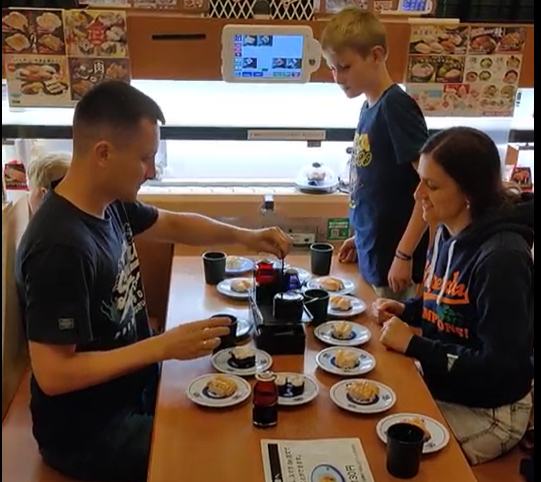
We ended up at Kura Sushi Binario Umeda because it was pouring. We’d come back from a day trip to Nara, got soaked somewhere between the station and dinner, and walked in wet and starving with two children. It turned out to be one of the easiest meals of the whole trip.
Conveyor-belt sushi is the single most underrated family meal in Japan, and Kura Sushi is one of the big chains that does it. But the system — the ticket queue, the touchscreen, the plates — is not obvious if you’ve never done it, and getting it wrong with hungry children is miserable. So here’s how it works.
The short version
- You take a ticket, you don’t ask for a table. There’s a machine at the door. Take a number and wait for it to be called.
- We waited about 20 minutes on a rainy evening. Reasonable for a Saturday-feeling crowd.
- No reservation needed — the ticket system is the queue.
- You order on a touchscreen and your plates arrive on the belt. You are not waiting for a waiter, ever.
- Perfect with kids. They choose their own food, it arrives in a minute, and nobody has to read a menu in Japanese.
How we ended up there
Rain. Proper rain — the kind that arrives while you’re between a station and a plan.
We’d spent the day in Nara with the deer (Nara day trip from Osaka) and come back into Osaka in the evening, wet through and past the point of negotiating about dinner. Kura Sushi Binario Umeda was there, it was warm, and it was open.
Which is a fair description of how most good travel meals actually happen, and why I’d rather write this than pretend we’d researched it.
The ticket queue: how it works
This is the part that confuses people, and it’s genuinely simple once you’ve seen it.
You don’t join a physical line or speak to anyone. There’s a ticket machine at the entrance. You take a numbered ticket and then you wait until your number comes up.
We waited about twenty minutes. On a wet evening with a full restaurant, that felt fine. It’s also twenty minutes in which nobody is standing in the rain, which is more than you can say for most queues.
Practical: don’t wander far. Numbers move faster than you expect, and if you miss yours you go back to the machine.
How the ordering works
Once you’re seated, there are two ways food reaches you, and they’re different.
The belt. Plates circulate past your table continuously. You take what you want as it passes. No ordering, no waiting.
The touchscreen. There’s a screen at the table. You order what you actually want, and it comes to you directly rather than going round the loop. This is the one to use with children — they can point at pictures and choose their own food, which turns dinner into an activity instead of a negotiation.
Your plates stack up at the table as you eat, and that stack is your bill. Which is either a helpful visual budget or a mild horror, depending on how many children you brought.
What it costs
The structure, at least, is simple: you pay per plate, plates are colour- or type-coded, and you can see exactly what you’re spending as it piles up. For a family, that’s unusually easy to control — far easier than a set menu where you commit before you know whether the kids will eat.
Why conveyor-belt sushi is the best family meal in Japan
I’d put it above ramen, above tempura, above anything else we ate on this trip, for one reason: children have agency.
In most restaurants in Japan, a child who can’t read the menu has to accept whatever the adults decide. Here they pick their own plates off a belt, or press a picture on a screen and watch it arrive. Our two ate more, complained less, and were entertained for the entire meal.
It also solves the fussy-eater problem, because there’s no commitment. A plate is two pieces. If it’s a failure, it’s a two-piece failure, and the next one is thirty seconds away.
And it’s fast. From sitting down to eating is almost nothing, which after a full day out is worth more than any amount of atmosphere.
Where it is
Kura Sushi Binario Umeda is in the Binario Umeda complex in Osaka, close to Umeda Station — one of the city’s main transport hubs, so it’s easy to reach from almost anywhere and easy to fold into a day that ends in the north of the city.
Would we go back?
Yes, and we’d plan for it rather than stumble into it. If I were writing our Osaka days again, conveyor-belt sushi would be the deliberate first-night dinner: cheap, fast, entertaining and completely low-risk with tired children.
The one caveat: at peak times the wait is real. Go early, or take the ticket and go and do something for twenty minutes.
More of our Osaka days
More of our Osaka and Japan guides
- Round1 Osaka — Spo-Cha vs arcade
- Nara day trip from Osaka
- Universal Studios Osaka with kids
- Osaka’s underground city
- Ippudo ramen in Osaka
- Navigating Japan with a JR Pass
Frequently asked questions about Kura Sushi Binario Umeda
How does the queue at Kura Sushi Binario Umeda work?
You take a numbered ticket from a machine at the entrance rather than joining a line or speaking to staff, then wait until your number is called. We waited about twenty minutes on a busy rainy evening. Don’t wander far, because numbers move faster than you expect.
Do you need a reservation at Kura Sushi?
No. The ticket machine at the door is the queue system, so you simply turn up, take a number and wait. Arriving outside peak dinner hours is the practical way to keep the wait short.
How do you order at Kura Sushi?
Two ways. Plates circulate past your table on the belt and you take whatever you want as it passes, or you order directly from a touchscreen at the table and your plates are delivered to you. The touchscreen is the better option with children, because they can choose from pictures themselves.
Is Kura Sushi good for families with kids?
It is one of the easiest family meals in Japan. Children choose their own food from pictures or off the belt, plates arrive in under a minute, and because a plate is only two pieces there is nothing to lose if something isn’t a hit. There is also no menu to read in Japanese.
Where is Kura Sushi Binario Umeda?
It is in the Binario Umeda complex in Osaka, close to Umeda Station, one of the city’s main transport hubs. That makes it easy to reach from most parts of the city and a practical stop at the end of a day out.
How much does Kura Sushi cost per plate?
You pay per plate, with prices varying by plate type, and your stack of finished plates is your bill — which makes it easy to see what you are spending as you go. Kura Sushi ran a flat 100-yen-per-plate price for decades but has since ended it, so check the current price at the door rather than trusting older guides.

1 Comment